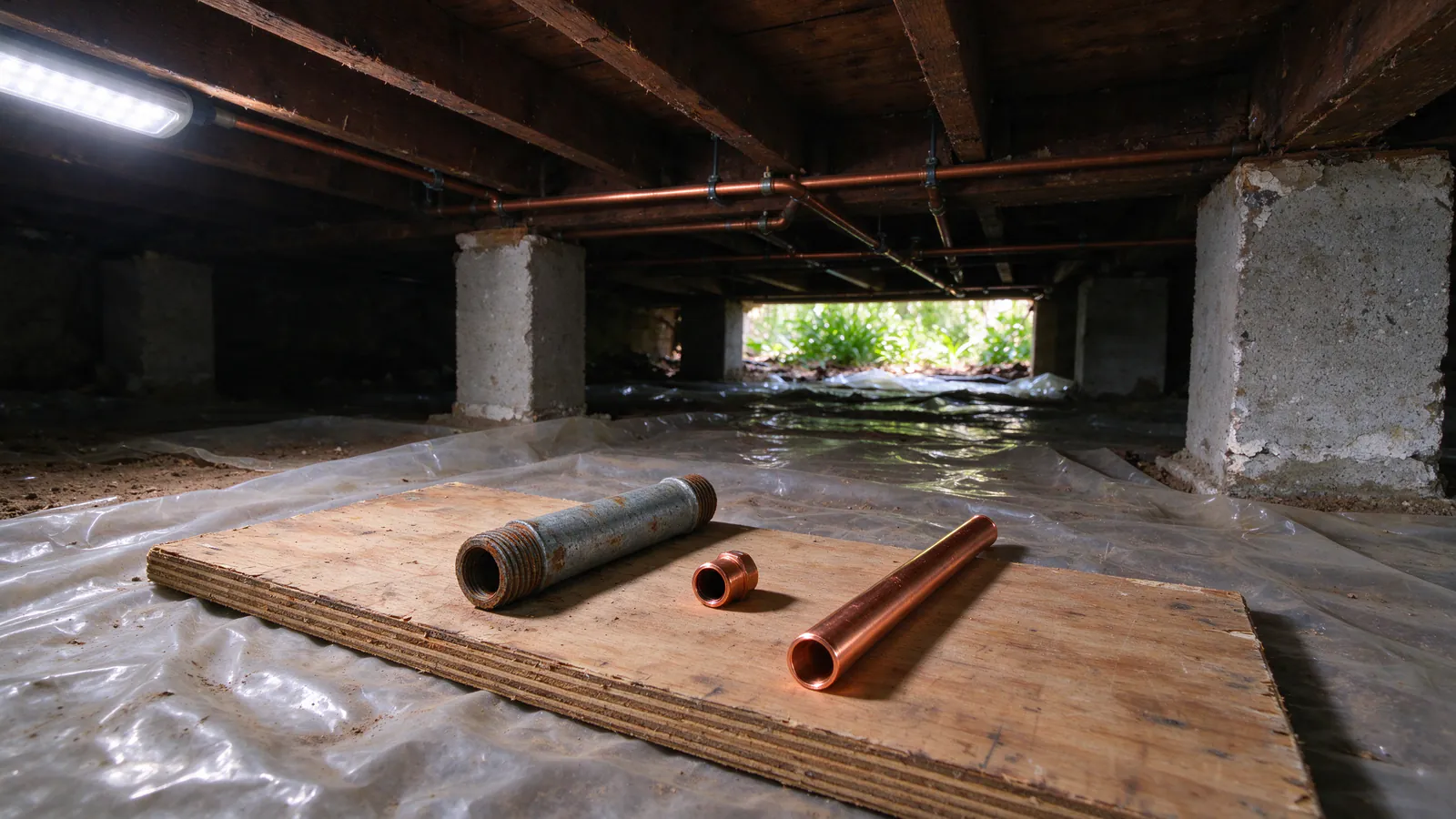
The shower drops to a trickle when someone starts the washer, or the upstairs sink barely runs. Low water pressure vs low flow is the first thing to sort out. Pressure is the force pushing water through the system, measured in psi with a gauge. Flow is how much water actually arrives, measured in gallons per minute. Fullbore Dallas Repiping replaces galvanized and other restricted water lines in Dallas homes, and new pipe only fixes one of these.
Your house can have good pressure and poor flow, or poor pressure that makes everything weak. The tests below tell them apart.
Pressure or flow: what’s the difference?
Pressure is the push behind the water when nothing is running, called static pressure. Flow is the volume that comes out when you open a fixture. Good static pressure with weak flow means something in the path is choking the water. Low static pressure means the supply itself is weak, and everything downstream suffers with it.
Think of a garden hose. Pressure is how hard the spigot pushes; flow is how much comes out the end. A kinked hose has full pressure behind the kink and a trickle at the nozzle. Corroded galvanized pipe is a kinked hose spread through the whole house.
Two tests you can run this weekend
Test pressure with an inexpensive gauge threaded onto an outdoor hose bib near the main shutoff, with everything off inside. Test flow by timing how long a fixture takes to fill a one-gallon bucket. Compare several fixtures, hot and cold, upstairs and down, to see where the flow drops off.
- With all fixtures and appliances off, read the static pressure at the hose bib.
- Open a bathtub faucet fully and watch the gauge. A big drop with good static pressure points to a restriction or undersized pipe.
- Time how long a one-gallon bucket takes to fill at the kitchen, a bathroom sink and a tub, on cold and on hot.
- Take the aerator off any slow faucet and test again.
Write the numbers down. They tell us far more than “the shower is weak.”
Weak at every tap?
Low static pressure at every fixture, hot and cold, points toward the supply side: a failing pressure-reducing valve, a main shutoff that isn’t fully open, a restricted or leaking service line, or low pressure in the street. Replacing the pipes inside your house fixes none of those.
Some Dallas houses have a PRV near the main shutoff that lowers street pressure to a safer level, and a worn one can stick low. The main shutoff may have been partly closed during an old repair and never fully reopened. On older lots, a galvanized service line can be as choked as interior pipe, and it is a separate scope; our guide to repiping and water service lines explains why. If your neighbors have the same problem, ask Dallas Water Utilities about the supply.
Good pressure, but water barely runs?
Good static pressure with weak flow means something in the path is restricting the water: a clogged aerator or showerhead, a worn cartridge, a partly closed stop valve, scale at the water heater inlet, or corroded pipe. If it’s one fixture, it’s a fixture problem. If it’s everywhere, or worst at the end of long runs, the pipe is the suspect.
Just one fixture
Start with the aerator and showerhead, which collect scale in Dallas’s hard water, reported at 120 to 155 mg/L as calcium carbonate in a December 2023 City memo. Then check the stop valve under the fixture and the cartridge inside the faucet.
Only the hot side
Weak flow on hot only points to the water heater: a partly closed inlet valve, scale or sediment at the connections, or galvanized nipples on the heater that have rusted nearly shut. Check those before suspecting the hot lines.
Lots of fixtures, worse at the far end
When flow drops at many fixtures, worst in the upstairs bathroom or at the far end of the house, and especially when running two fixtures at once starves both, the pipe is likely restricted or undersized. Galvanized steel is the usual culprit in older Dallas houses: rust deposits called tuberculation narrow the bore over decades. Our guide to brown water and rusty pipes covers the other signs.
Weak flow at more than one fixture?
We test pressure and flow, find where the restriction is, and tell you whether new pipe would fix it.
Should you worry about low pressure?
A sudden drop at every fixture can mean a leak, a main break or a failed PRV, so check the meter with everything off to see whether water is moving. A slow decline over years isn’t an emergency, but it usually means a restriction is getting worse. Pressure that’s too high is a problem too: it strains fixtures and can make pipes bang.
If the meter moves with everything off, you may have a hidden leak, possibly under the slab. Slab leak rerouting is one way we deal with that.
When new pipe fixes it
A repipe fixes flow lost to restricted or undersized pipe, most often galvanized steel. New pipe sized for your fixture count brings flow back at the far end of the house. It won’t raise street pressure, fix a failing PRV or clear a clogged faucet, so we rule those out first.
If the restriction is confined to one area, a partial repipe may be enough. If it’s throughout, our guide to repair or repipe walks through the decision, and the whole-house repiping page covers the full job. We often include a new PRV and main shutoff where the old ones are worn, and pressure that comes back after a repipe sometimes reveals water hammer the old restriction was hiding.
Bring your numbers
Bring your static pressure reading, the bucket times and which fixtures are worst. On the first visit we confirm the pipe material, test the PRV and main shutoff, and tell you whether the restriction lives in the pipe. Get an estimate to start, or check what you have with our pipe identification guide.