You’re trying to work out whether your house has the pipe everyone warns about. Learning how to identify water pipe material comes down to where pipe is exposed and three checks: a magnet, a close look at the joints, and the printing on the pipe. Color alone will fool you. Fullbore Dallas Repiping replaces water supply lines in Dallas homes, and naming the pipe you already have is the first thing we do on every visit.
You don’t need to open a wall or touch equipment you’re unsure about. What you can see at the water heater, under sinks and at the main shutoff usually narrows it down.
Where to look in your house
Look wherever pipe is exposed: at the top of the water heater, under the kitchen and bathroom sinks, behind the washing machine, at the main shutoff near where the service line rises, at hose bibs, and in the attic if lines run overhead. Each place shows a different part of the system, so check several before you decide.
In a slab house, the water heater is usually the best view, because the hot and cold lines start there. Under sinks, look past the chrome supply tubes to where the pipe comes out of the wall or floor. In the attic, look along the framing above the bathrooms; lines that come up through the slab won’t show there, but lines that run overhead will.
Be careful around the water heater’s gas flue and electrical connections, and in the attic walk only on framing.
What each kind of pipe looks like
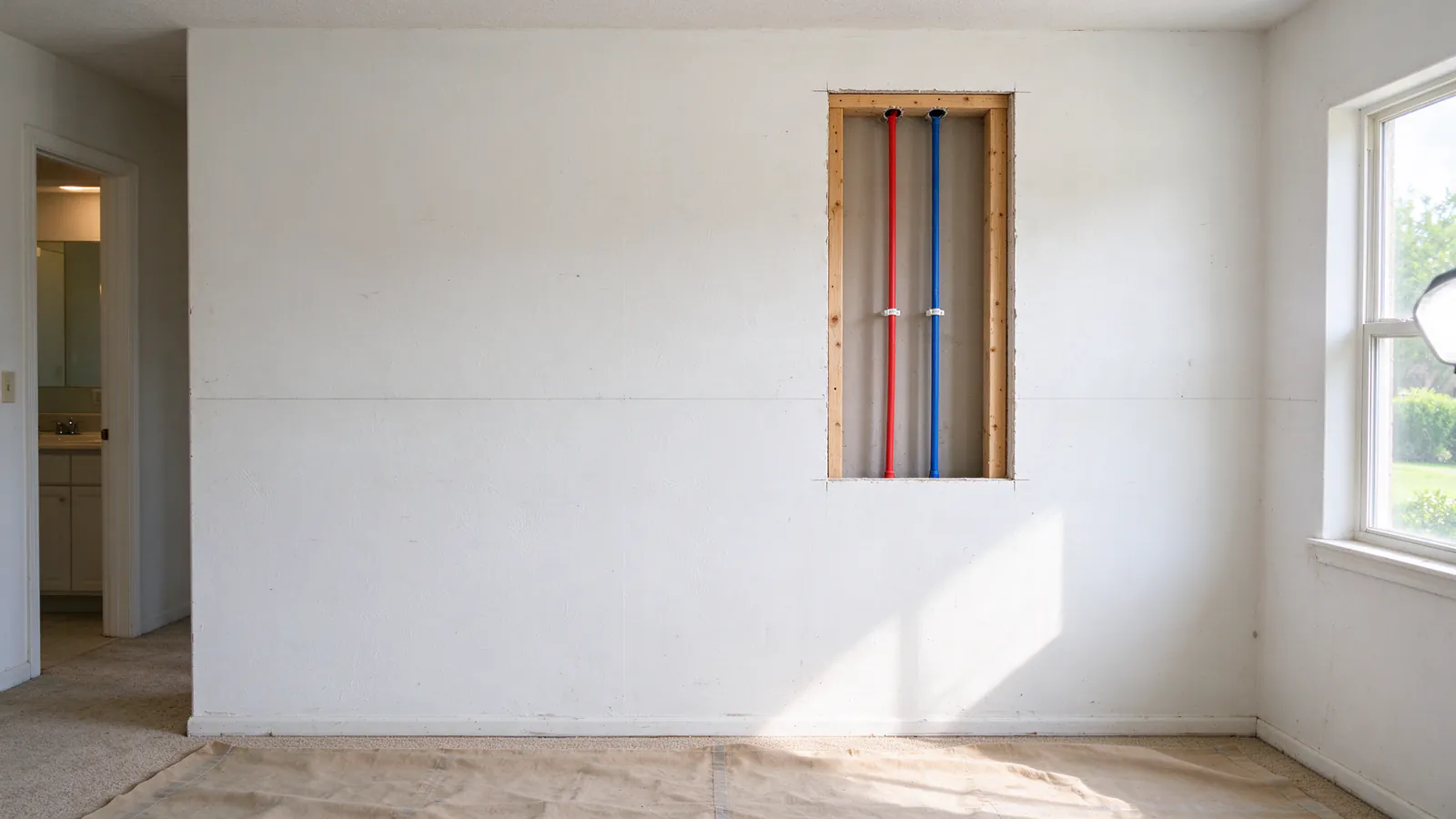
Galvanized steel is dull gray metal with threaded joints, and a magnet sticks to it. Copper is reddish brown metal with smooth soldered or pressed joints. Polybutylene is flexible gray plastic, often marked PB2110. CPVC is rigid cream or tan plastic with glued fittings. PEX is flexible plastic in red, blue, white or gray, printed with PEX and ASTM F876.
| Material | Look | Joints | Quick check |
|---|---|---|---|
| Galvanized steel | Dull gray metal, may show rust at threads | Threaded fittings | Magnet sticks |
| Copper | Reddish brown, may be green at joints | Soldered (sweat) or press fittings | Magnet does not stick; Type L printed in blue, Type M in red |
| Polybutylene (PB) | Flexible plastic, usually gray, sometimes white or blue | Acetal plastic or copper crimp rings | Often stamped PB2110 |
| CPVC | Rigid cream, tan or off-white plastic | Solvent-cemented (glued) fittings | Printed CPVC with ASTM D2846 |
| PEX | Flexible red, blue, white or gray tubing | Expansion fittings, crimp or clamp rings | Printed PEX with ASTM F876 and F877 |
Galvanized steel
Galvanized pipe is common in Dallas houses plumbed through roughly the 1950s and 1960s. Its joints are threaded, usually with visible threads where pipe enters a fitting, and a magnet sticks firmly. Corrosion often shows first at the threads, while inside, rust deposits narrow the bore. Our guide to brown water and rusty pipes covers the signs.
Copper
Scratch copper with a coin and you’ll see a bright copper color. Rigid copper tube carries a printed line along its length naming the type: blue for Type L and red for Type M. A green or white crust at a joint may be old flux or a slow weep, and it’s worth keeping an eye on.
Polybutylene
Polybutylene went into some Dallas construction from the late 1970s into the 1990s. It is flexible, usually gray, and often stamped PB2110. The fittings give it away: gray or white acetal plastic, or copper crimp rings. At the water heater it may show as a short gray flexible pipe; inside the house it often comes out of the wall to a stop valve. If you find it, read our page on polybutylene pipe replacement.
CPVC
CPVC is rigid and usually cream or tan. Its fittings are glued, so you’ll see a cemented joint with a slightly wider fitting and sometimes a purple primer stain. Older CPVC can turn yellow or brittle, especially near heat. Our page on CPVC pipe replacement explains when that matters.
PEX
PEX is flexible and printed with its type (PEX-A, PEX-B or PEX-AL-PEX), the standards ASTM F876 and F877, and often a maker’s name and date. Red and blue are common for hot and cold, but the color doesn’t mark a type. The fittings are brass or plastic with expansion rings, crimp rings or stainless clamp rings.
Found more than one pipe material?
We confirm what's behind the walls and what has failed, and your written estimate says what a repipe would replace.
Why color won’t settle it
Gray plastic can be polybutylene or PEX. White plastic can be PEX, CPVC or PVC on a line that isn’t water supply at all. Copper can be painted over. Galvanized can be wrapped in insulation. The printing, the joint type and a magnet beat color every time, though printing can wear off or disappear under paint.
Watch for pipe that isn’t water supply. Large white PVC or black ABS is drain pipe. Black iron with threaded joints near the furnace or water heater may be gas pipe. Gas lines are outside a repipe, and drains belong with drain or sewer work.
Does the age of the house tell you?
It tells you what was common when the house was first plumbed: galvanized through roughly the 1950s and 1960s, copper after, polybutylene and CPVC in some 1970s to 1990s homes, and PEX in newer work. It can’t tell you what is in your walls today, because repairs and remodels mix materials.
A 1955 house in East Dallas might have galvanized in the walls, copper added during a 1980s remodel, and PEX at the water heater from a recent replacement. Our guide to repiping older homes covers mixed systems in more detail.
What about the pipe out to the street?
The pipe from the meter to your house is the service line, and it is a separate scope from an interior repipe. Dallas Water Utilities has sent notices about service-line material, and an “unknown” listing is not a finding of lead. Our guide to repiping and water service lines explains the boundary.
Once you know what you have
Write down what you found at each spot, with a photo of the printing if you can. If it’s polybutylene, badly corroded galvanized or brittle CPVC, read our guide to repair or repipe. If it’s copper or PEX with one-off problems, a repair may be enough. When you want a second set of eyes, get an estimate; we confirm the pipe inside the walls and tell you plainly what we saw and what we’re inferring.