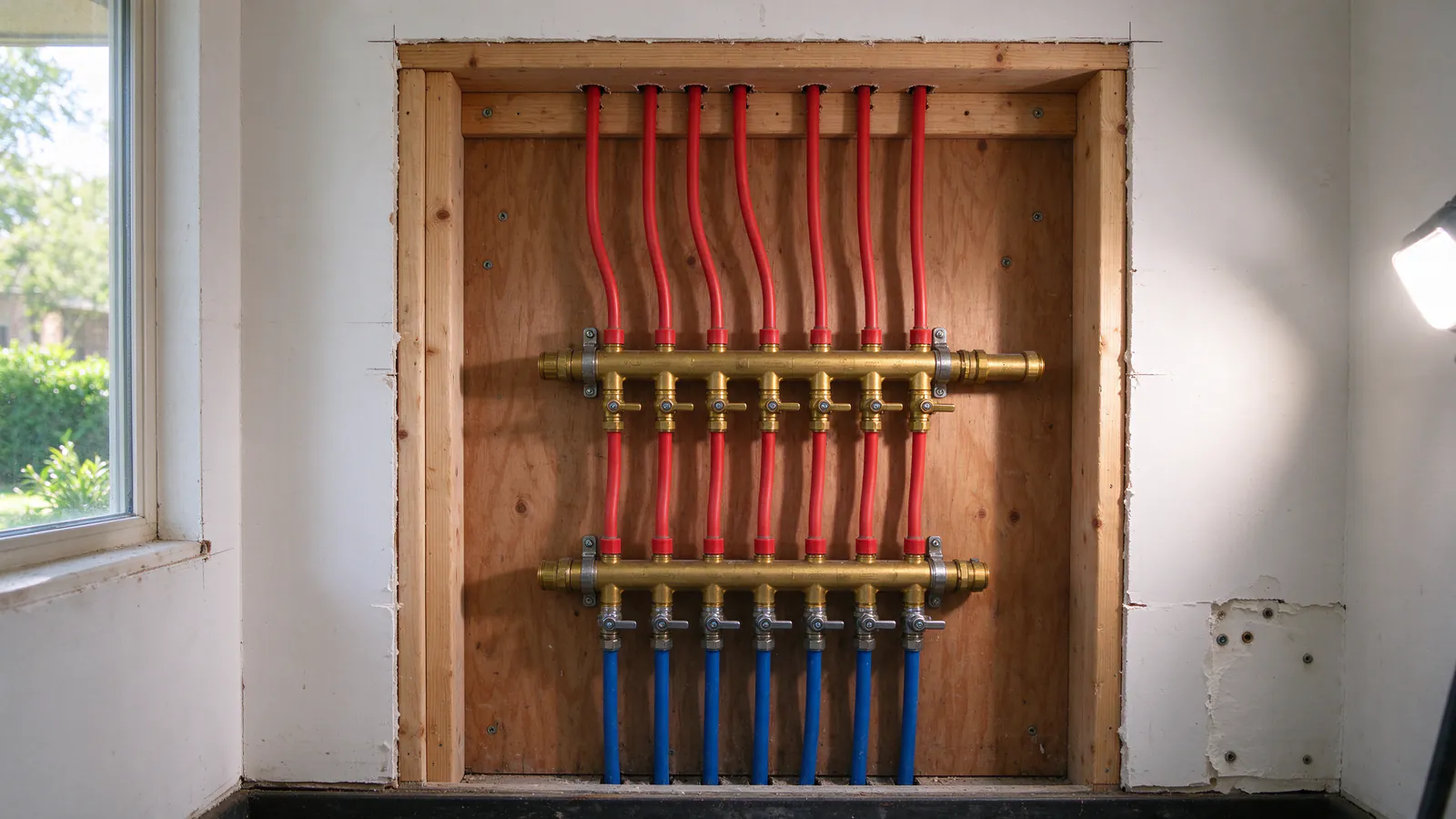
Every time the washing machine finishes filling, something in the wall goes bang. Water hammer after repiping is a pressure surge: when a valve shuts fast, the moving column of water stops and slams back through the pipe. New pipe can make it louder because full-bore lines carry faster flow than scaled old pipe, supports may need adjusting, or old air chambers came out. The fix is usually aimed at pressure, support or the valve itself.
Fullbore Dallas Repiping handles PEX repiping and whole-house repiping for Dallas homes, and we plan surge control into the job. Here’s how to work out what’s banging and what usually fixes it.
What’s actually banging
Water moving through a pipe carries momentum. A valve that closes in a fraction of a second, like the solenoid in a washing machine, dishwasher or refrigerator ice maker, or a single-handle faucet snapped shut, stops that water almost at once. The pressure spike runs back through the line and shakes it against the framing. You hear a bang or a run of knocks.
Higher pressure and faster flow both make the spike bigger. Long straight runs and loose supports make it louder.
Why it started after the new pipes went in
The restriction is gone
Old galvanized pipe narrowed by tuberculation throttled your flow. When galvanized pipe replacement brings full flow back, water moves faster and stops harder. Pressure the restriction used to hide now reaches the fixtures.
Supports and routing
PEX expands and moves more than copper. If it isn’t supported at the spacing the code and the maker set, or it passes through framing without sleeves, it can knock against wood. A long unsupported drop in a wall behaves like a drum.
The old air chambers are gone
Many older systems had capped vertical pipes behind fixtures meant to cushion surges. Most waterlogged long ago, but taking them out still changes how the system behaves. Today the answer is a mechanical water hammer arrestor at each quick-closing valve.
Pressure and thermal expansion
Service pressure varies from house to house in Dallas. The plumbing code calls for a pressure-reducing valve (PRV) where static pressure exceeds 80 psi. Once a PRV or check valve closes the system, heated water has nowhere to expand, so the water heater needs a thermal expansion tank. Without one, pressure climbs between uses and every surge gets worse.
Hearing new knocks since your repipe?
We start with a pressure reading and which appliance or fixture sets it off, then fix that valve, that support or the PRV.
Is it water hammer or something else?
| Sound | When it happens | Likely cause |
|---|---|---|
| Single bang | Washer or dishwasher fills stop | Quick-closing solenoid valve |
| Knock at a faucet | Single-handle lever shut fast | Fixture valve, local support |
| Sputter and spitting | First use after water was off | Air in lines, clears with use |
| Ticking in walls | As hot water starts or stops | Pipe expansion against framing |
| Hum or chatter | While a fixture runs | Loose washer, PRV or cartridge |
Air after a refill is normal and fades as you run the fixtures. Our water shutoffs guide covers what to expect when the water comes back.
How we track it down
Note which appliance or fixture sets it off, whether it’s hot, cold or both, and where in the house you hear it. A static pressure reading at a hose bib with everything off shows whether pressure is high, and a reading that climbs overnight points to thermal expansion. Our low pressure vs low flow guide uses the same gauge from the other direction.
What usually fixes it
- Water hammer arrestors at the washer box, dishwasher and ice maker connections, sized and listed for the job.
- Added supports or sleeves where a line moves against framing, reached from the attic or an access opening.
- PRV adjustment or replacement when static pressure is above 80 psi or the existing PRV has failed.
- Thermal expansion tank at the water heater in a closed system.
- Fixture valve changes where a cartridge closes unusually fast.
None of these means replacing the new piping. A full redo is only the answer if the installation is wrong throughout, and a support and pressure check will show that.
Old fixtures on new pipe
A partial repipe leaves some old pipe in service, and full flow from the new section can reach fixtures and valves that were used to a trickle. An old washer box, an aging ice maker valve or a worn toilet fill valve may start to chatter or knock where it never did. Those get fixed at the fixture. Listing which fixtures and valves stay on your estimate makes it clear what was renewed and what wasn’t.
When it’s more than noise
A bang followed by a drip, a wet ceiling, or water from the water heater’s temperature and pressure relief valve isn’t just noise. Shut off the water at the main and call for service. Repeated surges can also wear on older fixtures and on pipe kept in place after a partial repipe; our repair or repipe guide covers when that pipe is worth replacing too.
Before and after a repipe
If you’re planning a repipe, make sure the estimate lists the PRV, the expansion tank and arrestors at the quick-closing valves. If the noise started after one, start with a pressure reading. Our Dallas home repiping guide covers the full job, and you can get an estimate for a follow-up visit.