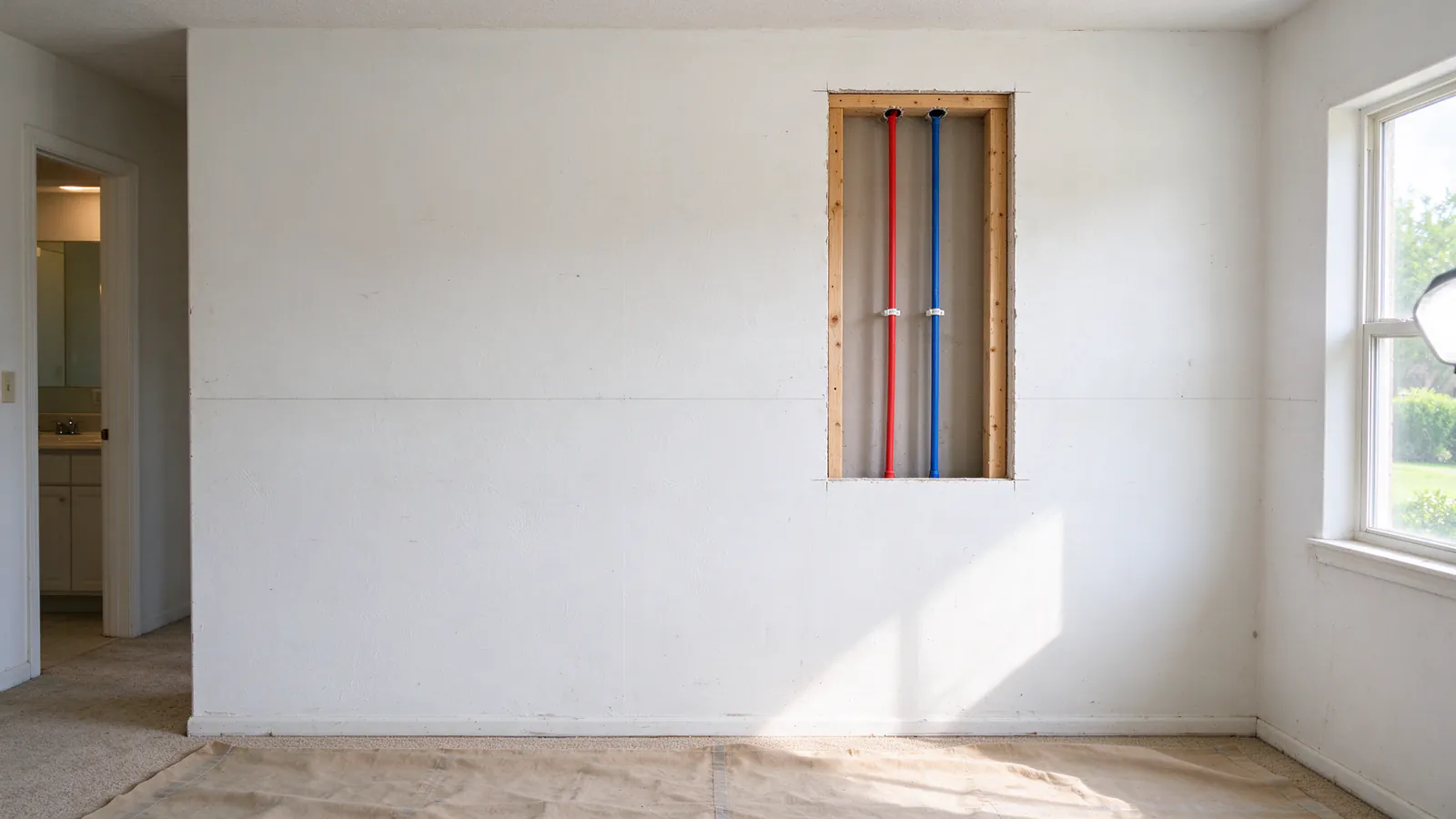
The plumber just fixed your third leak in two years and mentioned the word “repipe.” Whether to repair or repipe a house depends on whether its leaks are isolated or part of a pattern. Repair one failure with a known cause on otherwise sound pipe. Think about repiping when failures repeat on the same material in different places, when the pipe is a known problem material, or when flow is restricted everywhere. Fullbore Dallas Repiping replaces water supply lines in Dallas homes, from one run to the whole house.
Age alone doesn’t decide it. A 1960s copper system can be fine; a 1990s polybutylene system may not be. It comes down to what the pipe is, how it has been failing, and what you can see of it.
When a repair is the right call
A repair makes sense when there’s one failure with a clear local cause and the pipe around it looks sound: a fitting cracked by a nail during a remodel, a hose bib that froze, a supply line under a sink, a joint that let go at the water heater. Fix the failed piece and the rest of the system has no reason to follow.
Look at the pipe the repair exposes. A cut-out section shows the inside: clean copper with an even wall is a good sign; scaled galvanized with a narrowed bore, or copper with green pits inside, is not. That section is evidence, so ask to see it and keep it.
When the leaks are telling you something
A pattern points to repiping when the failures share a cause. Three pinholes on the same copper in two years, leaks at threads all over a galvanized house, or polybutylene fittings failing in different rooms all say the material is wearing out together. The next leak is coming, and every repair opens another wall.
The material often settles it. Galvanized steel corrodes from inside until flow drops and threads leak; our guide to brown water and rusty pipes covers the signs. Polybutylene has a known failure history at its fittings and in the pipe. Older CPVC can get so brittle that working on one joint cracks the next. Copper pinholes have several possible causes, explained in our guide to recurring pinhole leaks.
If you don’t know what pipe you have, start with our pipe identification guide.
The middle option: a partial repipe
A partial repipe replaces a defined part of the system: the hot side, one bathroom group, the lines in a remodel area, or a run that keeps leaking under the slab. It fits when the trouble is confined to that part and the rest of the pipe is sound. It leaves old pipe in service, so the boundary has to be clear.
Hot lines often fail first, because hot water is harder on metal pipe and moves faster through recirculating systems. That makes hot water line replacement a common partial job. In slab houses, one repeated slab leak is often handled by slab leak rerouting: we move that line overhead and abandon the under-slab section.
A partial repipe only works if everyone knows what it covers. Your written scope names what we replace, what stays, and where new meets old, with a listed transition fitting at each point. A partial repipe does not make the whole house new, and we won’t describe it that way.
Repair, partial or whole house, side by side
| Question | Repair | Partial repipe | Whole-house repipe |
|---|---|---|---|
| Fits when | One failure, known local cause, sound pipe | Failures confined to one side, area or run | Repeating failures across the system, or a problem material throughout |
| What stays | Everything except the repaired piece | Old pipe outside the stated boundary | Little or none inside the agreed boundary |
| Wall openings | One, at the failure | Along the replaced runs | Planned at each fixture group |
| Permit | Limited leak repair may be exempt | Permitted work | Permitted work |
| Risk of the next leak | Depends on the rest of the pipe | Remains in retained pipe | Moves to the new system’s fittings and workmanship |
Our repiping permits guide explains where Dallas draws the line between a leak repair and permitted repiping.
Not sure whether your house needs a repair or a repipe?
We start with what the pipe is, where it has leaked and what the cut sections show, and tell you which option fits.
Does this need deciding today?
A leak that’s active, near electrical, or soaking a ceiling means shut the water off and repair it now; the repipe decision can wait for that. A slow run of small leaks, rusty water or weak flow isn’t an emergency, but each leak risks hidden damage. Make the bigger decision before the next failure makes it for you.
Know where your main shutoff is and check that it closes. In many Dallas houses it sits where the service line rises from the ground or in the garage. If it’s seized, it’s worth fixing whatever you decide.
What each path costs
Repairs are cheap one at a time but add up, especially when each one opens a finished wall. A repipe costs more at once but ends the pattern. Our typical range for a whole-house PEX repipe in Dallas is $4,500 to $15,000 and up. Our typical range for a whole-house copper repipe in Dallas is $8,500 to $18,000 and up. Partial scopes we price from the section involved after the first visit.
Our Dallas repiping cost guide explains what moves a house within those ranges. Insurance may help with water damage from a sudden leak, but policies often exclude the pipe itself and slow leaks, so ask your insurer before you count on it.
Decide with evidence
Gather your leak history (dates, rooms, hot or cold), the pipe material and what was seen at each repair. On the first visit we tell you which option fits, why, and what it leaves in place. If you end up with two proposals, our repiping quotes and warranties guide shows how to compare them. Get an estimate to start, or read the whole-house repiping page to see what the full job covers.