You’ve heard strong opinions on both sides. In the PEX vs copper pipes decision, neither material wins in every Dallas house: both are permitted under the City’s plumbing code, and the right one depends on the route, the attic, the fixtures and what you value most. Fullbore Dallas Repiping does both PEX repiping and copper repiping in Dallas homes, so we have no reason to push you toward one.
Here’s how they compare on the points that actually change a Dallas repipe: how each is joined, how it routes through a slab house with an attic, how it handles heat and freezing, water chemistry, and cost.
Are both allowed in Dallas?
Yes. The City of Dallas lists the 2021 International Plumbing Code with Dallas amendments as its adopted plumbing code. PEX made to ASTM F876 and F877 with a listed fitting system, and copper tube made to ASTM B88, are both permitted for water distribution when installed to the code and the manufacturer’s instructions. Both are inspected the same way.
Drinking-water pipe and fittings are also certified to NSF/ANSI 61, and fittings to the lead-content limits of NSF/ANSI 372. Our Dallas repiping permits guide explains the rough-in and final inspections that apply to either.
How each one goes in
PEX is flexible tubing in three main types: PEX-A, usually joined with expansion fittings, where the tube is stretched over the fitting and shrinks back; PEX-B, usually joined with crimp or clamp rings; and PEX-AL-PEX, with an aluminum layer. Each has to use the fittings and tools its maker lists. The tubing bends gently around framing, so a run from the attic to a bathroom may need no fittings inside the wall.
Copper is rigid tube. Type L has a thicker wall than Type M. Joints are sweat (soldered) or press-connect fittings made with a certified tool. Every change of direction needs a fitting, and soldering in a lived-in house calls for heat shields and a fire watch. Press fittings skip the flame but cost more per joint.
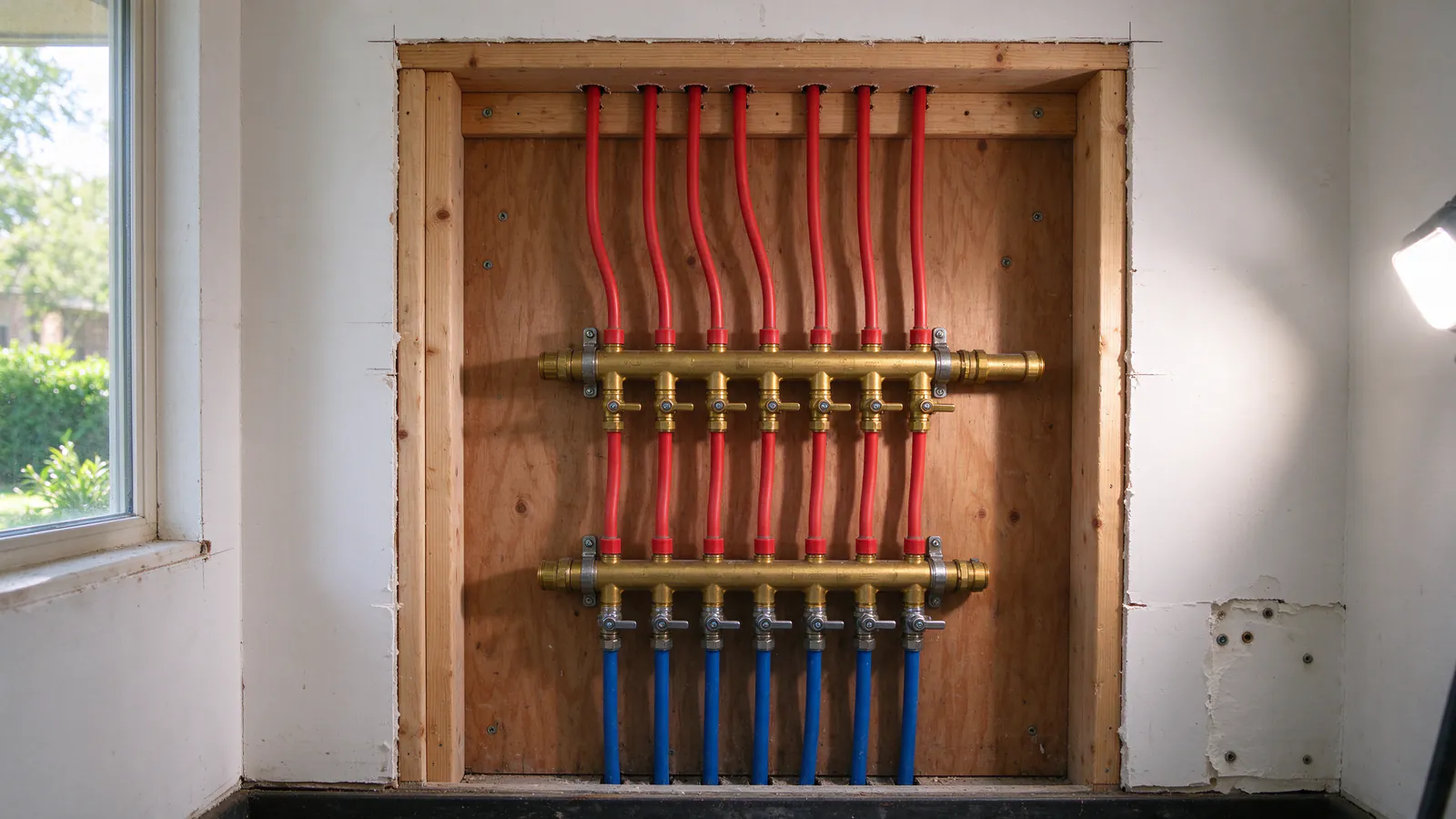
Either material can be laid out trunk-and-branch, with larger mains feeding smaller branches. PEX can also run as a home-run manifold, one line per fixture. Our guide to manifold vs trunk-and-branch covers that choice.
Which means fewer holes in your walls?
In many Dallas houses the original lines run under or in the slab, and we reroute new lines through the attic and down interior walls. PEX suits that route because it bends from attic to wall with few joints. Copper can do the same job, but each turn needs a fitting, and long runs need more openings to reach them.
That flexibility is the main reason PEX usually means fewer wall openings in a finished house. It isn’t a guarantee: tubing still has to reach each fixture, and connections still sit at stub-outs, the manifold and the water heater. Our guide to wall openings and drywall repair shows how we plan openings with either material.
What about attic heat and hard freezes?
Dallas attics get very hot in summer and can drop below freezing in winter. PEX handles the heat of a closed attic when installed per its maker, but it breaks down in sunlight and has to stay clear of flues and other heat sources. Copper shrugs off heat and light. Neither makes an uninsulated attic run safe in a hard freeze.
PEX can stretch a little as ice forms where rigid copper splits, which gives it some margin. That margin ends at the fittings, which can still fail. The National Weather Service office in Fort Worth documents the prolonged February 2021 freeze in Dallas, so whichever you choose, we keep lines low under attic insulation where we can, insulated, and away from gable vents and exterior walls. Our guide to attic pipe routing and freeze protection goes further.
Weighing PEX against copper for your house?
We map your attic route, fixtures and water heater, then show you how each material would run and what each would cost.
How Dallas water treats each one
Copper responds to water chemistry, flow velocity, workmanship and stray electrical current, and any of those can cause pitting and pinhole leaks. PEX isn’t affected by that corrosion, but its fittings, especially brass ones, and the quality of each expansion or crimp joint matter. Neither material is free of failure modes.
Dallas Water Utilities treats surface water with chloramine and corrosion control, and a December 2023 City memo reports hardness of 120 to 155 mg/L as calcium carbonate. That hardness builds scale in heaters and aerators with either pipe. Our guide to recurring pinhole leaks explains why copper pinholes have more than one possible cause, and why hardness alone isn’t one of the established ones.
Side by side
| Question | PEX | Copper |
|---|---|---|
| Joining | Expansion, crimp or clamp fittings listed for the tubing | Sweat (soldered) or press-connect fittings |
| Attic-to-wall routing | Bends with few joints | Fitting at each turn |
| Wall openings in a finished house | Often fewer and smaller | Often more, at turns and joints |
| Heat and sunlight | Must avoid UV and heat sources | Tolerates both |
| Freezing | Some stretch, but fittings can fail | Can split; insulation and routing matter either way |
| Water chemistry | Not subject to copper pitting | Can pit with chemistry, velocity or workmanship |
| Material and labor cost | Usually lower | Usually higher |
What each one costs
Our typical range for a whole-house PEX repipe in Dallas is $4,500 to $15,000 and up. Our typical range for a whole-house copper repipe in Dallas is $8,500 to $18,000 and up. More stories, more bathrooms, plaster or tile in the path, a slab route and fuller finish work push a house toward the top, and the written estimate after our first visit sets your number.
The gap comes from material and labor: copper costs more per foot and needs a fitting at every turn, while PEX usually means fewer openings to patch. Fixture count, route, permit, valves and water heater connections stay the same either way. Our Dallas repiping cost guide breaks down the rest. Some owners choose a mix, with copper at the water heater and in exposed spots and PEX through walls and ceilings, joined by listed transition fittings.
Choosing for your house
Choose PEX when the route runs through finished walls and an attic, and fewer openings matter most to you. Choose copper when lines will be exposed or close to heat, or when you prefer a metal system and accept more openings and a higher price. Either way, your written estimate names the pipe type and fitting system, layout, transitions and attic protection.
If you don’t know what you have now, our pipe identification guide helps. When you’re ready, get an estimate and we’ll show you how each material would route through your house.