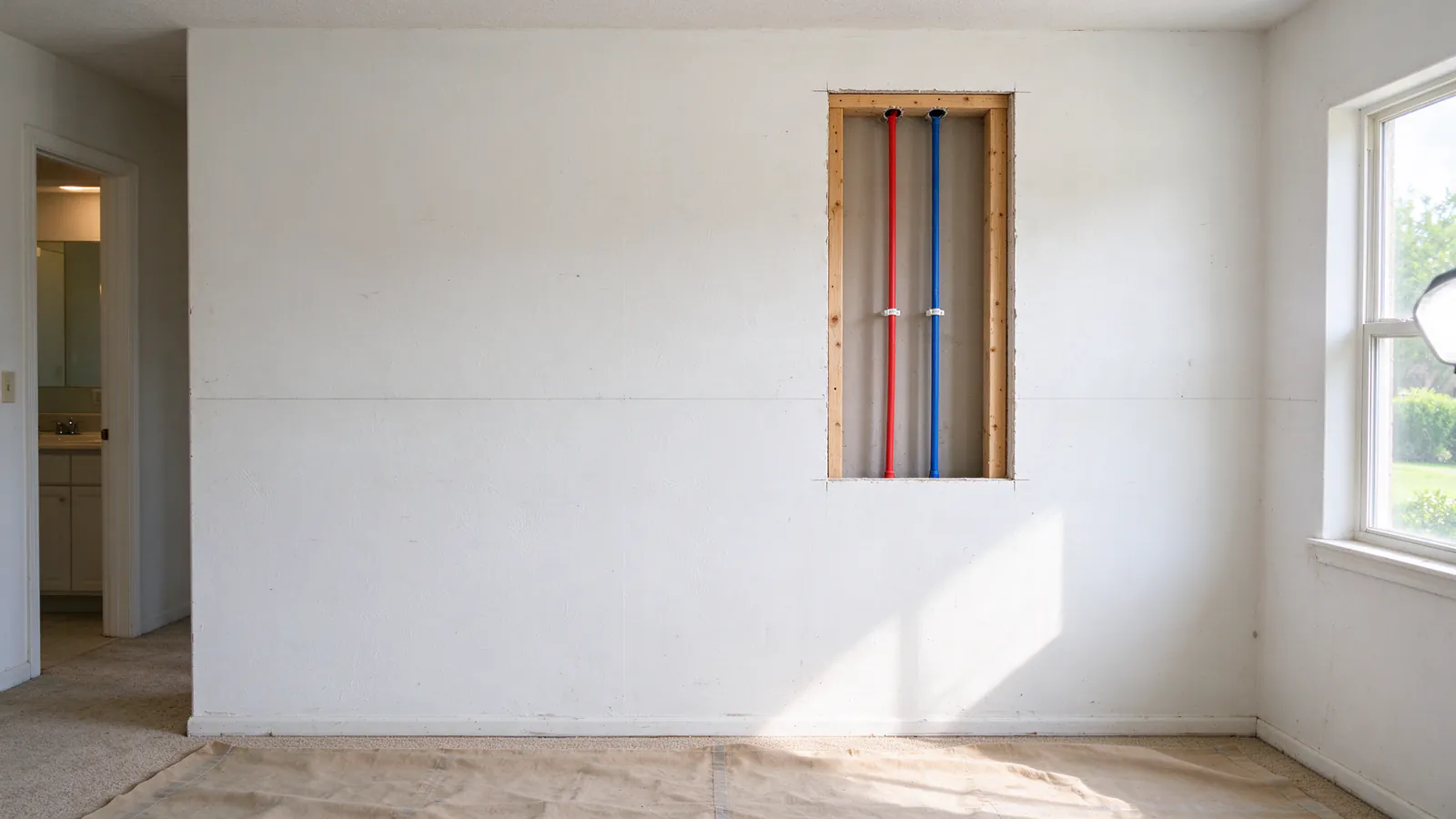
Our typical range for a whole-house PEX repipe in Dallas is $4,500 to $15,000 and up. Our typical range for a whole-house copper repipe in Dallas is $8,500 to $18,000 and up. Where your house lands depends on what the new pipe has to get through, and the written estimate after our first visit sets the number. Fullbore Dallas Repiping replaces the water supply lines in Dallas homes, and this guide covers what drives repiping cost in Dallas from one house to the next.
What pushes a house toward the top of the range?
Stories, bathrooms and what sits in the pipe’s path. A second floor, a third or fourth bathroom, plaster walls or tiled showers along the route, lines that have to come out of the slab, and patch-texture-paint finish work all push the number up. A compact one-story house with an open attic over every fixture wall sits toward the bottom.
A repipe is mostly labor, and the labor depends on how new pipe reaches each fixture. A one-story ranch in Lake Highlands with a walkable attic is a different job from a two-story house with tile surrounds and a finished ceiling between floors. Material, valves, permits and restoration then add their own spread.
Floor area is a poor shortcut. Two houses of the same size can differ by a full bathroom, an outdoor kitchen, a second water heater or a laundry room on the far side of the slab. The number of fixtures and how far apart they sit tell us more than square feet do. So does the route: lines that drop from an open attic need fewer wall openings than lines that have to snake through a second floor.
Do you need the whole house done?
The biggest swing in price is whether you need a whole-house repipe at all, or a partial repipe or a repair. Our repair or repipe guide works through that question. For a partial scope, a hot line or a slab reroute, we price the section in front of us after the visit rather than from a whole-house range.
If your house has galvanized, polybutylene or CPVC throughout, replacing it is a whole-house PEX or copper repipe, so the two ranges above are your starting point.
What moves the price up or down
The price rises with more fixtures and branches, longer and more complicated routes, more stories, tight attic access, finished surfaces such as tile and plaster, more valve and PRV work, water heater relocations and fuller restoration. It comes down where access is open, the layout is compact, and restoration is limited to what you agree in writing.
| Factor | Why it moves the price | What to ask |
|---|---|---|
| Fixture and branch count | Each sink, toilet, tub, shower, hose bib, ice maker and appliance needs a new line, stub-out, valve and connection | Which fixtures are included, and are any left on old pipe? |
| Stories and route length | Longer routes and floor-to-floor runs add pipe, fittings and labor | Where will the mains run, and how do lines reach the second floor? |
| Existing and new material | Removing or abandoning galvanized, polybutylene or CPVC differs; PEX and copper differ in material and labor | What is the existing pipe, and which pipe and fitting system is proposed? |
| Access | Open attics over interior walls are faster than finished ceilings, tight attics or slab work | Where are the access openings, and how big? |
| Retained piping and transitions | A partial scope needs listed transition fittings where new meets old | Exactly where does new pipe end and old pipe remain? |
| Valves, PRV and expansion tank | Replacing the main shutoff, PRV or adding an expansion tank is extra hardware and time | Are the main shutoff, PRV and expansion tank in scope? |
| Water heater connections | New supply and hot outlet connections, and any relocation or recirculation line | Are the heater connections included, with what fittings? |
| Permit and inspections | Permit, rough-in and final inspections, and scheduling around them | Who pulls the permit, and is the fee included? |
| Patch, texture and paint | Restoration can be a large share of the total, and quotes differ most here | Is restoration rough patch, texture match, or finished paint? |
| Occupied-home sequencing | Keeping a bathroom and kitchen working, protecting floors, daily cleanup | How are shutoffs scheduled while the household stays? |
Our PEX vs copper guide explains how material choice changes labor as well as material cost, and the guide to manifold vs trunk-and-branch shows how layout changes the amount of tubing and the number of fittings.
What’s inside a Dallas repipe price
A repipe price is made of labor, materials, permit and inspection costs, access and restoration. Two of those have public Dallas figures you can check yourself: plumber wages from the Bureau of Labor Statistics, and individual fee items on the City of Dallas fee schedule. The rest is set by your house, and your written estimate spells it out.
| Part of the price | What sets it | Local figure |
|---|---|---|
| Labor | Hours on site, number of workers, route difficulty, access | BLS OEWS, May 2025: mean $29.94 per hour for plumbers, pipefitters and steamfitters in Dallas-Fort Worth-Arlington, vs $34.70 nationally (about 14% lower); medians $29.45 vs $30.67. A wage is not a billing rate. |
| Trade permit handling | Permit type and how the application is reviewed | City of Dallas fee schedule: $25 stand-alone trade review document handling. The full permit total depends on permit type and valuation, and we list it on your estimate. |
| Reinspection | A failed or out-of-order inspection | City of Dallas fee schedule: $75 reinspection |
| Covering work early | Closing walls before the rough-in inspection | City of Dallas fee schedule: $200 unauthorized concealment, per trade |
| Code requirements | Materials, supports, valves and testing | City of Dallas adopts the 2021 International Plumbing Code with Dallas amendments; no fee, but it sets what must be installed |
| Pipe, fittings and valves | Material system, sizes, number of fittings and valves | Set by the material and fitting system named on your estimate |
| Access openings | Number and size of openings in walls and ceilings | Set by the access plan on your estimate |
| Drywall patch, texture and paint | Surface type, texture match, paint and who does it | Set by the restoration finish written into your estimate |
The BLS figures come from the Occupational Employment and Wage Statistics program, and they describe what plumbers are paid as employees. A wage is not a billing rate. The rate a plumbing contractor bills also carries licensing, insurance, vehicles, tools, permits, supervision and overhead, so multiplying a wage by hours does not give you a repipe price. What the comparison does show is that plumbing labor in Dallas-Fort Worth is paid somewhat below the national mean.
The fee items come from the City’s development services fee schedule. The concealment fee is the one to watch: rough-in work has to be inspected with walls open, so we never close a wall before the inspector has seen it. Our Dallas repiping permits guide explains the sequence.
Need a number for your own house?
We start with your fixture count, pipe material and attic access, and your written estimate puts the restoration finish in writing too.
How to compare two repipe quotes line by line
Put the quotes side by side and check that each names the same things: pipe material and fitting system, layout, every fixture and appliance, main shutoff and PRV, water heater connections, pipe left in place, permit and inspections, testing, access openings, and restoration to a stated finish. Totals only compare once the jobs match.
Some differences look like price gaps but are really scope gaps:
- One quote includes texture-matched patch and paint; another stops at rough drywall.
- One replaces the main shutoff and PRV; another reconnects to the old ones.
- One runs a home-run manifold; another runs trunk-and-branch with fewer feet of tubing.
- One includes the permit fee; another lists it as an extra.
- One leaves the ice maker or a hose bib on the original pipe.
Ask what happens if an opened wall turns up something unexpected, such as soft framing or an old leak, and how that gets priced. Read the warranty for what it covers and what it leaves out. Our repiping quotes and warranties guide has a full checklist, and the process and timeline guide shows how scheduling and shutoffs can differ between proposals.
Is there help paying for a repipe in Dallas?
For some owner-occupied homes, yes. The City of Dallas Home Improvement and Preservation Program (HIPP), administered by Volunteers of America Texas, offers major-systems repair assistance up to $24,000 as a forgivable loan for eligible homes. The City opens short application windows, and the program sets its own eligibility rules.
Check the program page at Volunteers of America Texas for the current window and requirements before you plan around it. Income, ownership and paperwork conditions apply, and the program decides what it funds. We are not a participant in the program, so you apply through the program itself.
Homeowners insurance is a separate question. A policy may cover water damage from a sudden leak while excluding the pipe that failed, so ask your insurer what it covers before any wall gets opened.
Using the cost estimator
Our repiping cost estimator takes your house’s details, such as stories, bathrooms, fixture count, existing pipe, attic access and the finish you expect, and shows which drivers will move your price. It is a starting point; your written estimate after the visit is the number to plan around.
If you’re not sure yet whether you need a repipe, the repiping assessment tool sorts your symptoms first, and our Dallas home repiping guide covers the whole subject.
Getting a number you can plan around
Our written estimate names the pipe and fittings, the layout, every fixture, the valves, the water heater work, the permit, the openings and the restoration finish. With all of that on paper, you can hold it next to any other quote on equal terms. Get an estimate for your house, or browse our repiping services to see which scope fits.