Your leaks are in the slab and nobody wants to jackhammer the kitchen floor. Repiping through attic space is how we usually get around that in a Dallas slab-on-grade house: new lines run overhead and drop down interior walls to each fixture. The catch is that your attic is the hottest space in the house in July and the coldest in a freeze, so the route, support and insulation matter as much as the pipe.
Fullbore Dallas Repiping replaces water supply lines in Dallas homes, and attic routing is a regular part of our PEX repiping and slab leak rerouting work. This guide shows what a well-planned attic route looks like and what to ask before we start.
Why your new pipes may go overhead
Many Dallas houses were built slab-on-grade, with supply lines running under or inside the concrete. Replacing them in place means cutting the slab inside finished rooms. Running new pipe overhead and abandoning the under-slab lines avoids that, which is why a repipe after a slab leak is so often an attic reroute.
The trade-off is exposure. Lines that used to sit in soil at a fairly steady temperature now cross a space that bakes all summer and drops below freezing in a hard winter. Pier-and-beam houses in older districts like Oak Cliff and East Dallas have a second option, the crawlspace, which has its own cold-weather limits.
Remember February 2021?
The National Weather Service Fort Worth office’s February 2021 winter event summary records 139 consecutive hours at or below freezing at DFW Airport, from the evening of February 13 to noon on February 19. The low reached minus 2 degrees Fahrenheit on February 16, and the February 15 high was lower than the record low for that date.
Length of cold matters more than one cold night. An attic line that shrugs off a few hours near freezing can freeze solid after several days, especially near soffit vents or where the ceiling insulation is thin. Our post on getting Dallas pipes through a hard freeze covers what to check after a cold snap.
How we lay out an attic route
Low and on the warm side
The protected place for a water line in your attic is down against the ceiling drywall, under the blown or batt insulation, where heat from the rooms below reaches it. A line strapped high on rafters or laid over the top of the insulation sits in attic air. We keep lines toward the middle of the house and away from eaves, gable-end vents and exterior walls.
Pipe insulation and air sealing
Where a line can’t be buried, foam pipe insulation sized to the tubing slows heat loss in winter and heat gain in summer. On its own it doesn’t make a line freeze-proof. Sealing the holes where lines drop through the top plates also keeps cold attic air out of the wall cavities, which protects the stub-outs below.
Support and protection
The International Plumbing Code, adopted in Dallas as the 2021 edition with local amendments, sets maximum support spacing for each pipe material, and PEX needs closer support than copper. The tubing maker’s instructions add bend-radius limits and protection where tubing passes through framing or crosses sharp edges.
Ask where every attic line will run before you sign.
Our estimate for an attic repipe shows the route, the insulation plan and where the shutoffs sit, so heat and cold are handled in the design, not after the first freeze.
Will attic heat hurt PEX?
PEX tubing is listed under ASTM F876 and carries pressure ratings at elevated temperatures on its print line. Dallas attic heat is within what makers design for when the tubing is installed to their instructions. The firmer limits are clearance from gas flues, water heater vents and other heat sources, which the maker specifies, and sunlight. PEX makers limit UV exposure, so we cover tubing near a skylight, open gable vent or ridge gap.
Your attic air handler or furnace matters too. We route lines so they don’t sit on equipment, block service access or pass close to a flue. Copper handles heat and UV well but still needs supports, insulation and freeze protection; our PEX vs copper guide compares the two.
Why the cold tap runs warm in summer
In summer, water sitting in a cold line that crosses the attic warms between uses, so your first draw from a cold tap runs warm until the line clears. Short attic runs, burying them under insulation and sleeving them all cut that down. Where the framing allows, we can run lines through interior walls or soffits instead of across the open attic.
The same exposure works on hot lines in winter: they lose heat between uses, which can lengthen your wait for hot water. Our slow hot water guide covers that side.
What if your attic is a poor route?
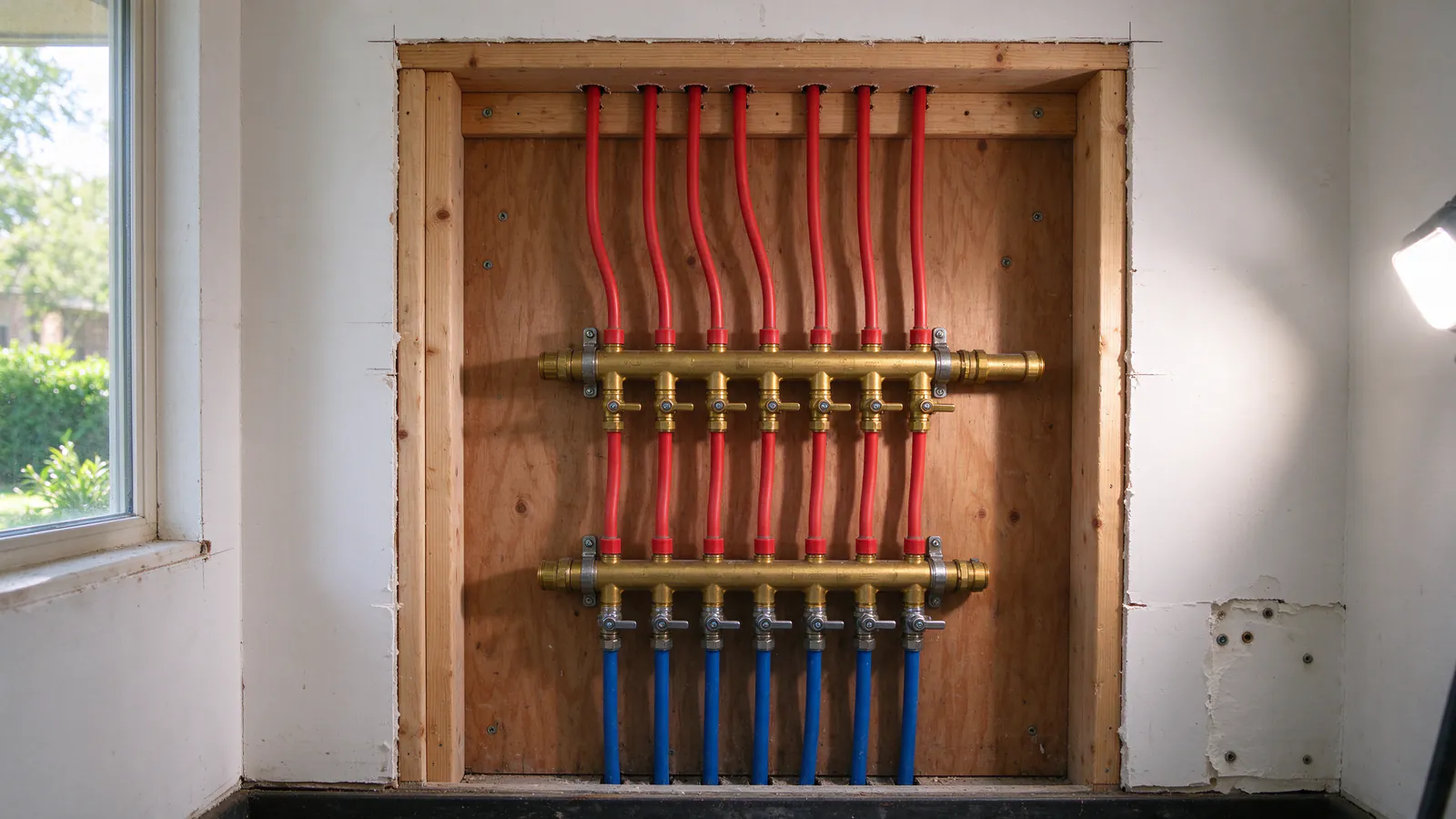
Some houses have little attic over the wet rooms, a flat or cathedral ceiling, or a second story in the way. Then we look at interior wall chases, a soffit built into a closet or hallway ceiling, or the crawlspace in a pier-and-beam house. Choosing a manifold or trunk-and-branch layout also changes how many lines have to cross the attic.
What your written scope should say
Your estimate should name the route for each fixture group, the support method, where pipe insulation goes, how penetrations are sealed, and where the main and branch shutoffs sit. It should also say whether attic insulation we disturb gets put back. Our quote comparison guide lists the other line items, and the City’s rough-in inspection happens before any attic route is covered; our Dallas permits guide explains the timing.
Where to start
If your house has under-slab supply lines, repeated leaks or a broken pipe from a past freeze, get an estimate. We start in the attic: its access, the insulation depth and the space over each bathroom and the kitchen. That tells us whether an overhead route is practical in your house.