You need to know how long the house will be torn up, whether you’ll have a working shower, and when the walls get closed. How long does repiping take? It depends on your house, and a fixed number given before anyone has seen the attic, the fixture count and the finishes is a guess. A repipe runs in four stages: planning and permit, installation and cutover, inspection and testing, then restoration.
Fullbore Dallas Repiping handles whole-house repiping and partial repiping for Dallas homes. Here are the stages in order, so you can see where the time goes and what to ask when you compare schedules.
Stage 1: Our first visit, your estimate and the permit
On the first visit we map your system: the main shutoff, the water heater, the PRV if there is one, each fixture group, the attic or crawlspace and the finishes on the walls we’d open. Your written estimate follows, naming the material, layout, route, valves and restoration level.
A repipe is permitted plumbing work in Dallas. The City of Dallas Building Inspection page says replacing or rearranging supply piping isn’t covered by the limited exemption for stopping a leak, so the permit goes in through DallasNow, the City’s permitting portal. Our Dallas repiping permits guide covers what the City reviews.
What speeds it up or slows it down
How quickly you choose between options, whether a homeowners association or building manager has to approve access, and how long the permit takes to issue. Commercial and multifamily jobs add shutdown notices and scheduling around occupants.
Stage 2: Protection, openings and new pipe
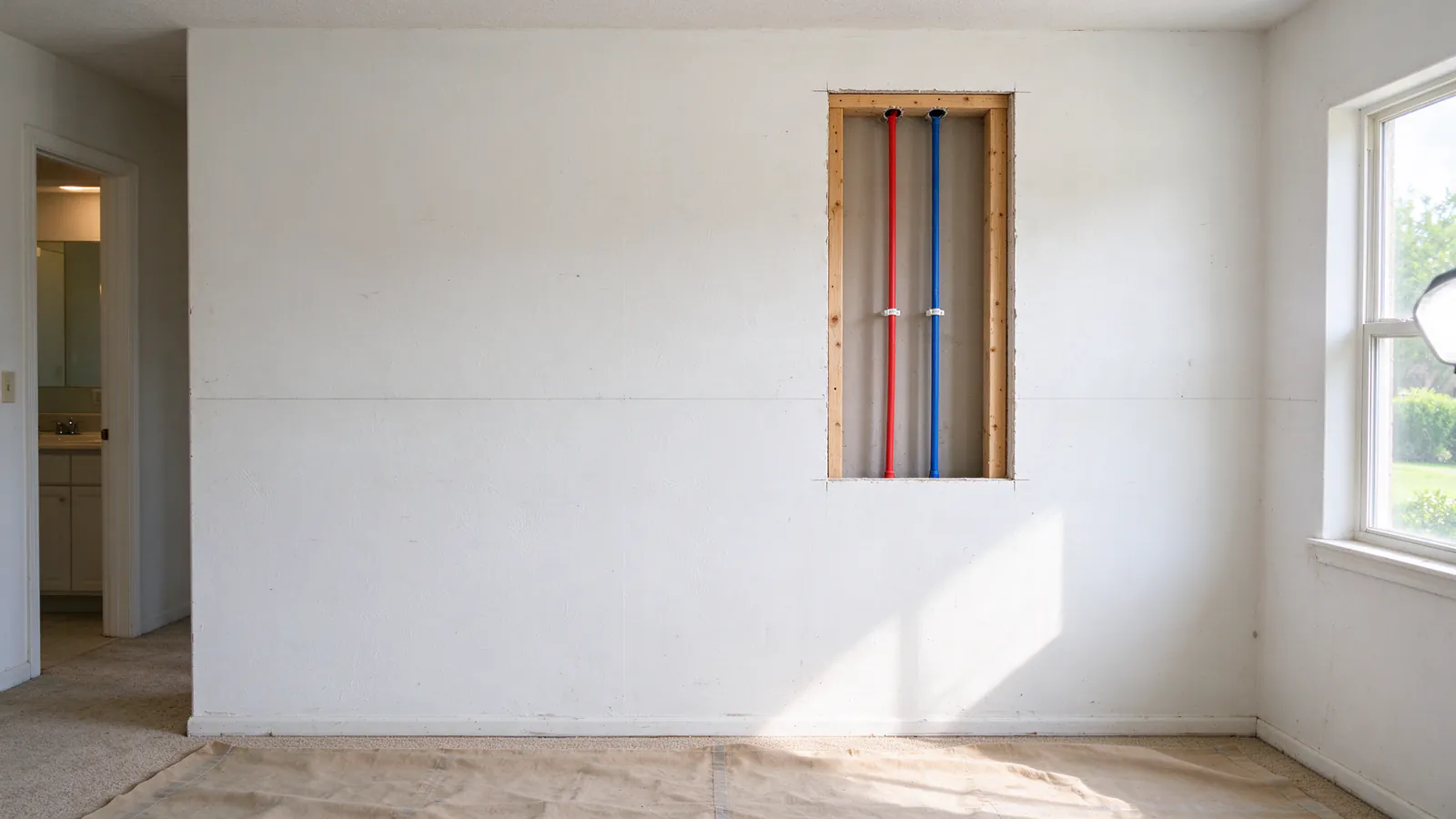
First we protect the work areas: floor coverings, plastic over furniture and closed doors to keep dust where it belongs. Then the access openings get cut where the route needs them, usually behind or below fixtures and at the tops of walls where lines drop from the attic. Our wall openings guide explains where they go and why.
New piping usually goes in while your old system stays in service, so you keep water through most of this stage. Lines are supported, sleeved where they cross framing and insulated in the attic.
Cutovers
The water goes off when the new system is tied in at the main, at the water heater and fixture by fixture. We often do this in phases so a bathroom stays usable. Our water shutoffs during repiping guide covers how we plan it.
Stage 3: Pressure test, rough inspection and flushing
Before anything is covered, the new piping is pressure tested so a weak joint shows while it can still be reached. Since June 1, 2026 the City of Dallas has coordinated plumbing and mechanical rough and final inspections, according to its Building Inspection notice. For you, that means a rough inspection with walls open, then a final after fixtures are reconnected.
The City fee schedule dated July 1, 2025 lists a $75 reinspection fee and a $200 unauthorized concealment fee per trade for covering work before it’s inspected. That’s a good reason we never rush the patching.
After cutover the lines are flushed to clear debris, aerators and fixture screens are cleaned, and every stop and connection is checked for leaks.
Want a schedule built around your house, not a guess?
Your estimate breaks the job into stages, names when water will be off and when the City inspection falls, and says who handles patch and paint.
Stage 4: Patch, texture and paint
Restoration is often the longest stretch on the calendar, because drywall compound needs drying time between coats before texture and primer. Matching an existing spray texture or plaster finish takes care. Whether paint is included, and to which edge, is something we settle on the estimate rather than at the end.
What makes your timeline longer or shorter
| Factor | Why it adds or saves time |
|---|---|
| Fixture and bathroom count | More stub-outs, connections and cutovers |
| One story or two | Second floors need routes through chases or ceilings |
| Attic access and height | Low or crowded attics slow routing and support work |
| Finishes | Tile, plaster and cabinets need different access than drywall |
| Occupied house | Water restored between phases; daily cleanup |
| Inspection scheduling | Patching waits for the rough inspection to pass |
| Concealed conditions | Damage or old repairs found behind walls need approval to fix |
Pipe material matters less than most people expect. PEX usually needs fewer joints than copper, but access, inspection and restoration set most of the schedule. Our PEX vs copper guide compares the two on their merits.
Can you stay in the house?
Most Dallas households stay home through a repipe. It works when the schedule builds in water restored between phases, one usable bathroom where possible and daily cleanup of the work areas. It also adds a little time, because each stage ends with the house handed back to you. If the house is empty, the same work can run more continuously.
Questions to ask about any schedule
- Which days will water be off, and for which fixtures?
- When is the rough inspection expected, and who schedules it?
- Who patches, textures and paints, and when?
- What happens to the schedule if the inspection calls for a correction?
Where to go next
Our Dallas home repiping guide puts the timeline in context with materials, access and cost, and the cost estimator shows which drivers affect your price. When you want a schedule for your own house, get an estimate.