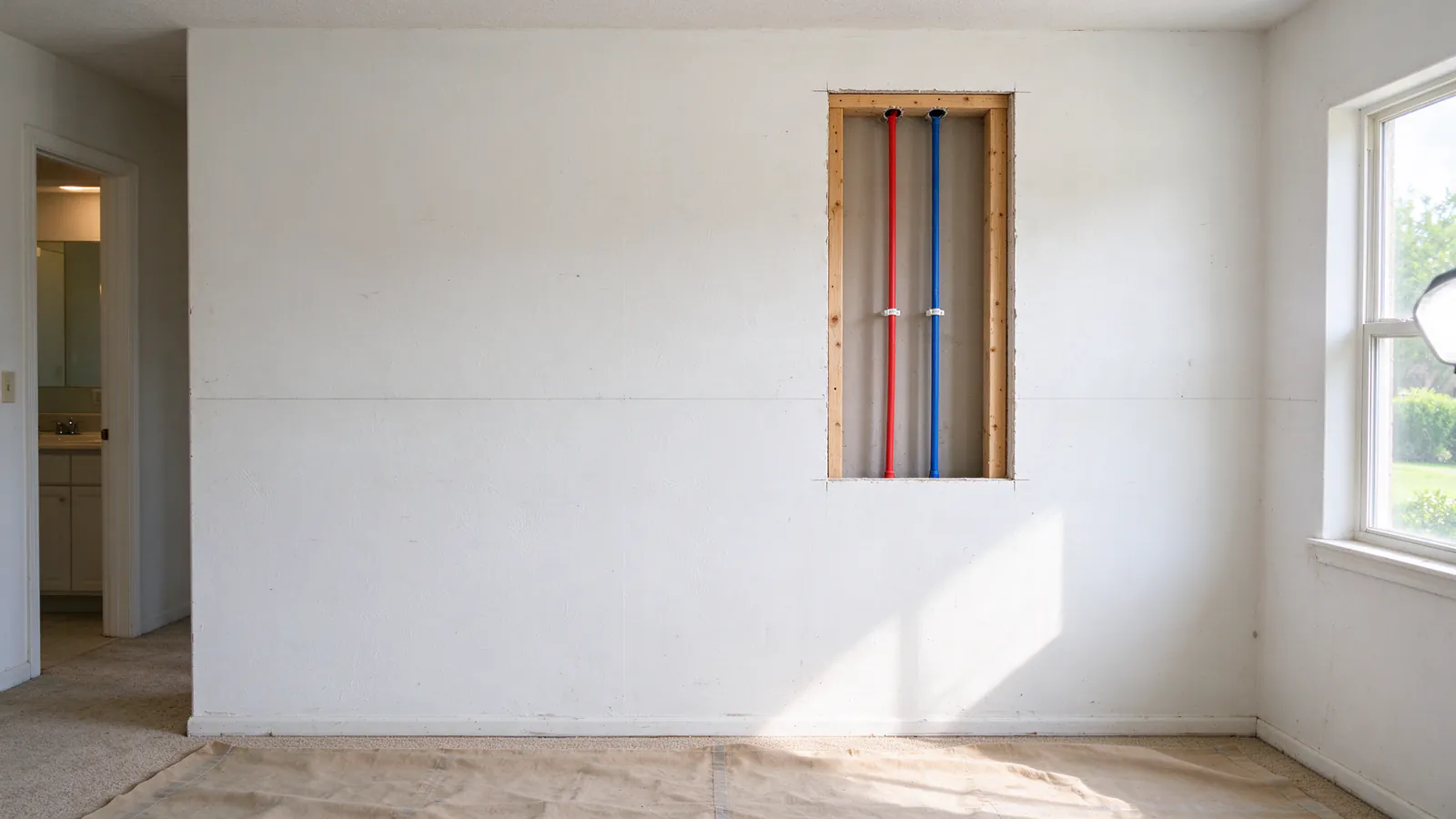
You found a second pinhole leak in a year, or the water runs brown after a weekend away, or the shower drops to a trickle whenever someone starts the dishwasher. This Dallas home repiping guide explains what is happening inside your walls and what a repipe would actually involve. Fullbore Dallas Repiping replaces the hot and cold water lines in Dallas homes, from one bathroom branch to the whole house, and this is the long version of what we walk through with you on the first visit.
Each section answers one question and links to a shorter guide that goes deeper. Read it straight through, or jump to the part that matches what is happening in your house.
What a repipe replaces, and what it leaves alone
A repipe replaces the water lines inside your house: the hot and cold pipes that run from the main shutoff to the water heater, every fixture and every appliance. It does not touch your drains or sewer pipe, gas piping, irrigation, or the underground service line from the meter. Each of those is separate work, and we tell you when a problem sits outside our scope.
That boundary matters because what you see doesn’t always start inside it. A slow drain is a drain problem. A soggy patch in the yard between the meter and the house is usually a service-line problem. Brown water at every tap at once may start at the utility main. Our guide to interior repiping versus water service lines covers that outside boundary, including the notices Dallas Water Utilities sent about service-line material.
Inside the boundary, you have two kinds of job. A whole-house repipe replaces all of the supply piping. A partial repipe replaces a defined section, such as the hot side or one bathroom group, and leaves the rest in service. When we write a partial scope, we name exactly where new pipe meets old.
How water gets from the street to your shower
Water comes through the Dallas Water Utilities meter near the street, along the underground service line to your house, and into a main shutoff. From there it may pass a pressure-reducing valve (PRV), then splits into a cold trunk and a line to the water heater. Hot and cold branches then feed each group of fixtures.
The meter, service line and main shutoff
The meter belongs to the utility. The service line from the meter to the house is generally yours, and on older lots it may be galvanized steel or copper. Your main shutoff is often where that line rises out of the ground near a hose bib or comes into the garage. On the first visit we find it with you and check whether it actually closes, because a shutoff that won’t hold makes every later step harder.
The pressure-reducing valve and expansion tank
Some Dallas houses have a PRV near the main shutoff that brings street pressure down to a level your fixtures can live with. A PRV wears out, and a failing one can cause both weak showers and banging pipes. Where a PRV or check valve makes your system closed, the water heater needs a thermal expansion tank to take up the extra volume water gains as it heats. We look at both before we write a scope.
Slab lines, attic routes and the water heater
Many Dallas houses are built slab-on-grade, so the original supply lines run under or in the concrete and come up through the floor at each fixture. Others already run overhead in the attic and drop down walls. Your water heater, whether it sits in the garage, a closet or the attic, is where hot distribution begins.
Our slab leak rerouting page explains why moving lines out of the slab is usually the practical fix, and the guide on attic pipe routing and freeze protection covers what going overhead asks of you.
What kind of pipe is in your house?
Your pipe usually reflects when the house was plumbed. Galvanized steel was common through roughly the 1950s and 1960s, copper took over after that, some 1970s to 1990s construction used polybutylene or CPVC, and newer work is mostly PEX. Remodels mix them, so one Dallas house can hold three materials at once.
Our pipe identification guide shows you how to tell them apart at the water heater, under sinks and at the main shutoff. Color alone won’t settle it. Here is what each material is and how it tends to fail.
Galvanized steel
Zinc-coated steel pipe joined with threaded fittings. Once the zinc is gone, the steel corrodes from the inside and builds rust deposits called tuberculation, which narrow the bore year by year. You notice weak flow, rusty water and leaks at the threads. Galvanized pipe replacement is one of the main reasons older Dallas houses get repiped.
Copper
Rigid tubing joined by sweat (soldered) fittings or press-connect fittings. Type M copper has a thinner wall than Type L, and both are made to ASTM B88. Copper lasts a long time in many houses, but it is not immune: water chemistry, velocity, workmanship and stray electrical current can all cause pitting and pinhole leaks. Our guide to recurring pinhole leaks covers the patterns.
Polybutylene (PB)
Gray, sometimes white or blue, flexible plastic pipe used in some construction from the late 1970s into the 1990s, joined with acetal plastic or copper crimp fittings. Polybutylene and its fittings have a well-known history of failing, often without warning. Where we confirm it, polybutylene pipe replacement is usually a whole-system decision.
CPVC
Cream or tan rigid plastic pipe joined with solvent cement. CPVC can turn brittle with age and heat, and older runs can crack when someone moves them during a repair, which makes patching harder each time. Our CPVC pipe replacement page explains when replacing beats patching.
PEX
Flexible cross-linked polyethylene tubing made to ASTM F876 and F877, in PEX-A, PEX-B and PEX-AL-PEX versions, joined with expansion fittings or crimp or clamp rings depending on the system. PEX bends around framing with fewer joints, which is why it shows up in so many repipes, but copper is still a sound choice. Our PEX vs copper guide compares them on the points that matter in a Dallas house.
Why pipes start leaking
Supply pipes fail by corrosion, by material aging, at fittings and joints, and from outside forces such as freezing, rubbing against framing or movement in a slab. Which one depends on the material. Galvanized rusts from inside, copper pits, polybutylene and older CPVC lose strength, and any pipe can let go at a poorly made joint.
The question we ask first is whether your failure is isolated or spread out. One leak at a fitting that got bumped during a kitchen remodel says little about the rest of the house. Three pinholes in two years on the same copper, or rust at every faucet, points at the pipe itself. That difference drives the choice between repairing and repiping.
Symptoms can fool you. Brown water can come from the water heater or a utility main rather than your own pipe. A weak shower can come from a PRV or a clogged aerator rather than a restricted line; our guide to low water pressure vs low flow separates them. A repipe fixes problems that live in the pipe, and we will tell you when yours doesn’t.
What Dallas water and weather do to pipes
Dallas Water Utilities treats surface water with chloramine and corrosion control, and a December 2023 City memo reports hardness of 120 to 155 mg/L as calcium carbonate, which is moderately hard to hard. That hardness builds scale in water heaters and aerators. Winter freezes, including February 2021, and summer attic heat add stress wherever pipes run outside conditioned space.
Water chemistry
Dallas Water Utilities describes its supply as treated surface water, disinfected with chloramine, with corrosion control treatment. Hard water leaves mineral scale in tank water heaters, on aerators and inside valve cartridges. That scale can cut flow at one fixture, but hardness is not an established cause of copper pinhole leaks, and no single water factor explains every leak pattern.
Freezing and attic heat
The National Weather Service office in Fort Worth documents below-freezing weather in Dallas, including the prolonged February 2021 winter storm, when temperatures stayed below freezing for days. Pipes in attics and exterior walls are the exposed ones. Those same attics bake in July, so when we run PEX overhead, it is supported, kept out of sunlight and away from heat sources per the maker’s instructions, and insulated against the next cold snap.
Repair it, repipe part of it, or repipe the whole house?
Repair a single confirmed failure on pipe that is otherwise sound. Consider a partial repipe when the trouble is confined to one material, one side (often hot) or one area. Consider a whole-house repipe when failures keep repeating across the system, the material has a known failure pattern, or flow is restricted everywhere. Evidence decides, not the age of the house alone.
Our repair or repipe guide walks through the decision. These are the signals we weigh most:
- How often and how far: a second or third leak in different rooms on the same material.
- What the pipe is: polybutylene, badly restricted galvanized or brittle CPVC change the math.
- Whether walls are open anyway: replacing pipe during a remodel saves you opening them twice.
- What stays: a partial scope connects old pipe to new, and that transition needs the right fitting.
Hot water line replacement is one common partial scope, because hot lines run warmer and faster and often fail first in copper and galvanized systems.
Do you need a permit to repipe in Dallas?
Yes. The City of Dallas treats replacing or rearranging water supply piping as permitted plumbing work; its limited exemption covers stopping a leak, not repiping. The permit goes in through DallasNow, the City’s permitting portal, and the work gets a rough-in inspection with walls open before anything is covered, then a final inspection.
The City’s plumbing and mechanical page lists the 2021 International Plumbing Code with Dallas amendments as the adopted code. PEX and copper are both permitted when they are listed and installed to that code and the manufacturer’s instructions. Since June 1, 2026, the City coordinates plumbing and mechanical rough and final inspections.
Covering work before it is inspected costs money: the City’s fee schedule lists an unauthorized concealment fee of $200 per trade and a $75 reinspection fee. We schedule the rough-in before any wall closes for that reason. Our Dallas repiping permits guide explains who pulls the permit, when the inspector comes and what to keep at the end.
How a repipe runs from start to finish
A typical repipe moves through our first visit and your written estimate, the permit, layout and access openings, running new lines while the old system stays live, a planned shutoff for the tie-in, pressure testing and flushing, rough-in inspection, closing walls, and final inspection. The order can shift with the house, and your written scope sets it.
On the first visit we map your existing material, the main shutoff, the water heater, each fixture group, attic and wall access, and finished surfaces such as tile and cabinets. Then we settle the layout: trunk-and-branch, with larger mains feeding smaller branches, or a home-run manifold with one line per fixture. Our guide to manifold vs trunk-and-branch explains how each affects flow, hot-water wait and shutoffs.
New lines are run and stubbed out at each fixture with new stop valves and escutcheons. Then the water goes off for the changeover, when fixtures and the water heater are connected and old lines are cut out or abandoned. The system is pressure tested, flushed and inspected. Our process and timeline guide covers what drives the length of each phase, and the guide to water shutoffs during repiping shows how a household keeps working through the outages.
Want to know what a repipe would involve in your house?
We start with your pipe material, fixture count and attic access, and you get a written estimate you can compare.
Will you have to open walls?
Some walls and ceilings almost always get opened, because new pipe has to reach each fixture. How many depends on attic access above each fixture wall, the layout, and how many fixtures sit on exterior walls. The openings are usually small and planned in advance. Who patches, textures and paints them is written into your scope.
In a single-story Dallas ranch with a walkable attic, lines drop straight down interior walls and often need only an opening near the fixture. Two-story houses, finished ceilings and tiled walls take more planning. Where pipes pass through a rated wall, such as the one between the garage and the house, firestopping is restored.
Restoration is where quotes differ most. One may include drywall patch, texture match and paint; another stops at rough patch. Our guide to wall openings and drywall repair lists what a restoration scope should name. Older houses with plaster walls, original tile or historic trim need extra care, covered in our guide to repiping older homes.
What a repipe costs in Dallas
Our typical range for a whole-house PEX repipe in Dallas is $4,500 to $15,000 and up. Our typical range for a whole-house copper repipe in Dallas is $8,500 to $18,000 and up. A second story, more bathrooms, plaster or tile in the path, a route that has to come out of the slab, and fuller finish work push a house toward the top.
We don’t price by the square foot. Your number comes from the fixture and branch count, stories and route length, the existing and new material, attic and wall access, valves and PRV, water heater connections, the permit and inspections, how much patch and paint you want, and working around a household that stays put. The written estimate after our first visit lists each of those and sets the price.
Our Dallas repiping cost guide breaks a price into its parts, including Bureau of Labor Statistics wages for plumbers in Dallas-Fort Worth and the City’s permit fee items. The repiping cost estimator walks through the drivers for your own house, and the repiping assessment tool helps you sort symptoms before you call.
How to compare two repipe quotes
Compare quotes line by line, not by the total. Each should name the pipe material and fitting system, the layout, every fixture and appliance connection, valve and PRV work, water heater connections, any pipe left in place, who pulls the permit, testing, restoration and written warranty terms. If two quotes describe different jobs, their totals don’t compare.
Confirm that whoever does the plumbing holds a current Texas plumbing license, and ask who will be on site each day. Ask what happens if an opened wall turns up something hidden, like an old leak or soft framing. Our repiping quotes and warranties guide gives you a checklist for reading the warranty itself, including what it leaves out.
What changes after the new pipes are in
Expect clear water after flushing, steady flow at your fixtures, and new shutoff valves that actually close. A couple of things surprise people: hot water can take a little longer to arrive with some layouts, and new pipes can bang if a valve shuts fast or a run is loosely supported. Both have known causes and fixes.
Our guide to slow hot water after repiping explains why line volume and layout affect the wait and when recirculation helps. The guide to water hammer after repiping covers surge, support and valves. Keep the final inspection record, the material and fitting details, and a sketch of any pipe left in place with your house papers. Insulated attic lines stay insulated, and in a hard freeze the usual precautions still apply.
Where to go from here
Start with what you can see: the pipe at the water heater and under sinks, your leak history, and whether the problem shows at one fixture or all of them. Then look at the service that fits: whole-house repiping, PEX repiping, copper repiping, or the full list of services. If you own an apartment or condo building, read our apartment and condo repiping and commercial repiping pages, since shared risers change the plan.
When you’re ready, get an estimate. Ours names the pipe, the route, the openings and the restoration in writing, so you can hold it next to any other quote. The service areas page shows the Dallas districts we work in, and the full guide library has every topic above in shorter form.