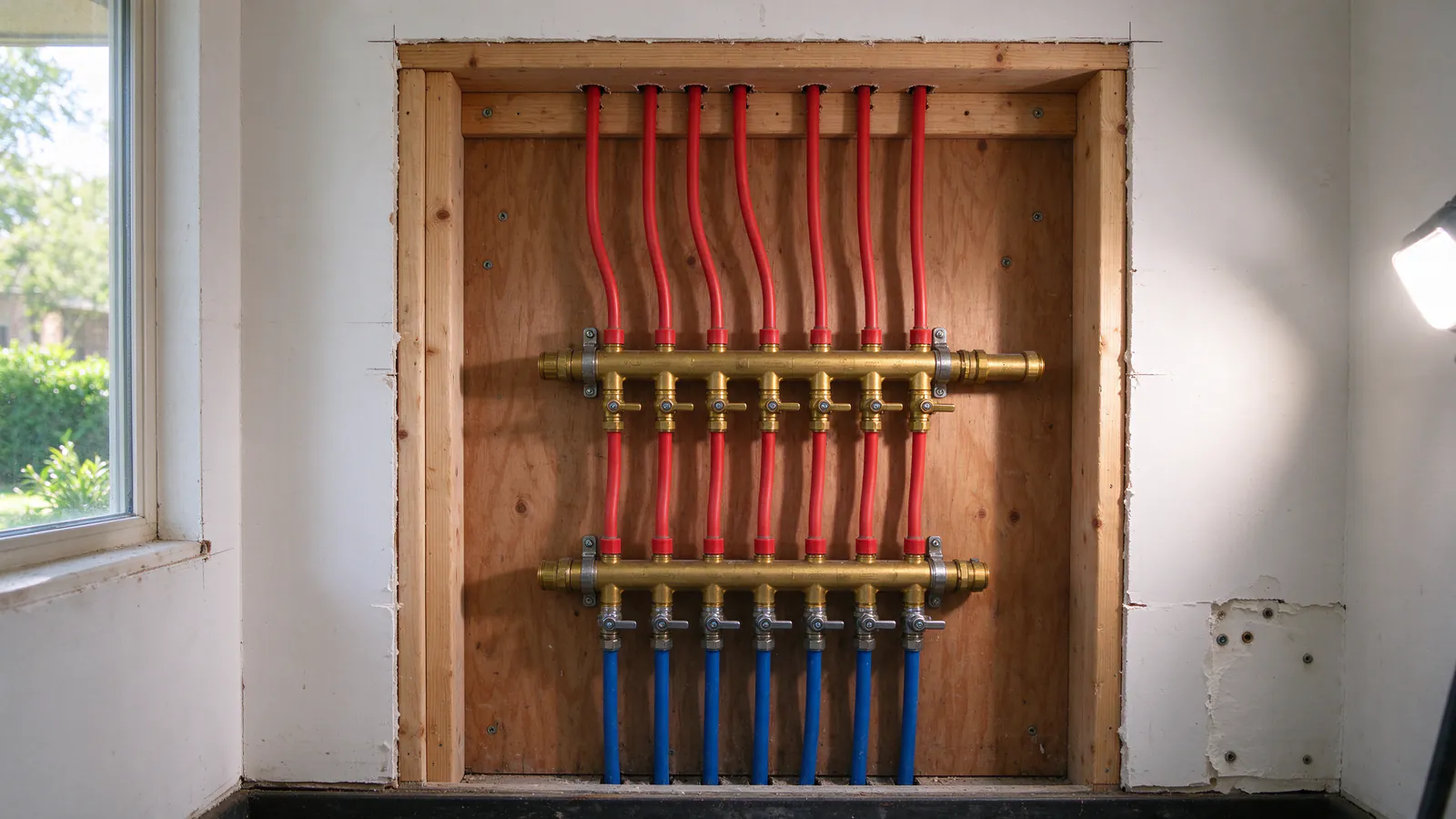
Most of the year nobody in Dallas thinks about frozen pipes, and then a cold front parks over North Texas for a week. Dallas pipes in a hard freeze fail where the house is least protected: attic lines near the eaves, supply pipes in exterior walls and hose bibs. Freezes are rare enough here that many houses were never built with them in mind. A few steps before a cold snap, and a careful check after, prevent most of the damage.
Fullbore Dallas Repiping replaces water supply lines in Dallas homes, including PEX repiping that reroutes lines through the attic. This post covers what a Dallas freeze does to water lines, what to check afterward, and when repeated damage points to a different route rather than another repair.
Remember February 2021?
The National Weather Service Fort Worth office’s summary of the February 2021 winter event records two long stretches at or below freezing at DFW Airport: 93 hours from February 9 to 13, then 139 consecutive hours from the evening of February 13 to noon on February 19. The low reached minus 2 degrees Fahrenheit on February 16, and the high on February 15 was colder than the record low for that date.
The length mattered more than the low. Attic and wall-cavity pipes that ride out one cold night can freeze solid over several days, and many broke when the ice thawed and pressure came back.
Which of your pipes are most exposed?
Attic runs
Many Dallas slab houses have supply lines overhead, either from the original build or an earlier repipe. Lines laid over the top of the ceiling insulation, strapped high on rafters or run out toward the eaves and soffit vents sit in what’s nearly outdoor air. Our attic routing and freeze protection guide explains how a protected route stays low and on the warm side of the insulation.
Exterior walls and hose bibs
Kitchen sinks under windows, laundry boxes on outside walls and hose bibs all put water next to the cold side of the house. A hose left connected traps water in the bib. Older pier-and-beam houses add crawlspace lines exposed to wind through the foundation vents.
Before the cold arrives
- Disconnect garden hoses and cover hose bibs with insulated covers.
- Open sink cabinet doors on exterior walls so room heat reaches the pipes.
- Let a slow drip run at fixtures fed by exposed lines, unless the City asks residents to conserve.
- Find your main shutoff and make sure it closes.
- Keep the thermostat steady overnight instead of setting it back.
After the thaw
When temperatures climb, check before you assume all is well. With every fixture and appliance off, watch the leak indicator on the water meter; if it moves, water is going somewhere. Then look at the ceilings under the attic route, the walls behind exterior-wall fixtures and each hose bib. Run each fixture hot and cold and listen.
A split in PEX or a failed fitting may only leak once the ice melts. Copper often splits along its length. Polybutylene and brittle CPVC can crack at fittings that were already weak. Our pipe identification guide helps you tell which you have.
Does PEX survive a freeze better than copper?
Somewhat. PEX can stretch as ice forms, so the tubing often survives a freeze that would split copper. That isn’t the same as freeze-proof: fittings, manifolds and valves can still fail, and ice still blocks flow. Copper carries cold faster and splits more readily. Either way, the route and the insulation matter more than the material; our PEX vs copper guide compares them.
When freeze damage means it’s time to reroute
One split at a hose bib is a repair. A pattern is different. If the same attic run has broken in more than one freeze, if exposed lines run along the eaves with nowhere better to go, or if the freeze hit polybutylene or galvanized pipe that was already leaking, rerouting or a broader repipe may be the better answer. Our repair or repipe guide walks through that decision, and our water shutoffs guide covers what living through a repipe looks like.
If the cold keeps finding the same pipes
If every freeze finds the same lines, get an estimate. We look at the attic route, the insulation depth and the exterior-wall fixtures, and tell you whether moving the lines would end the cycle. Our Dallas home repiping guide covers the rest of the job.