Your house has plaster walls, original tile and a few decades of other people’s repairs, and you don’t want a repipe to wreck any of it. Repiping an older Dallas home differs from a newer one in three ways: the pipe is usually a mix from years of fixes, the walls and finishes are harder to open and match, and the house may need lead-safe work and an electrical bonding check.
Fullbore Dallas Repiping replaces galvanized and other worn water lines in Dallas homes, and older houses are where we spend the most time planning.
Here’s what to expect, what to ask, and how we protect what makes an older house worth keeping.
Is your house in an older part of Dallas?
Census figures show where older housing sits. The U.S. Census Bureau’s 2020-2024 American Community Survey estimates put the median home in ZIP 75218 at 1960, with 79.4% of units built before 1980, and in ZIP 75223 at 1955. In ZIP 75224 the median is 1958, with 78.8% of units built before 1980.
Other ZIPs with older stock include 75208 in Oak Cliff, with a median of 1960, 75214 in East Dallas at 1967, 75229 in North Dallas at 1967, and 75232 in Southwest Dallas at 1967, with 76.1% of units built before 1980. These figures describe ZIPs, not single houses, and they don’t prove what pipe is in yours.
The City of Dallas historic preservation pages describe even older districts, such as Winnetka Heights in Oak Cliff, platted in 1908, with one-story bungalows and two-story Prairie houses.
What’s probably in your walls
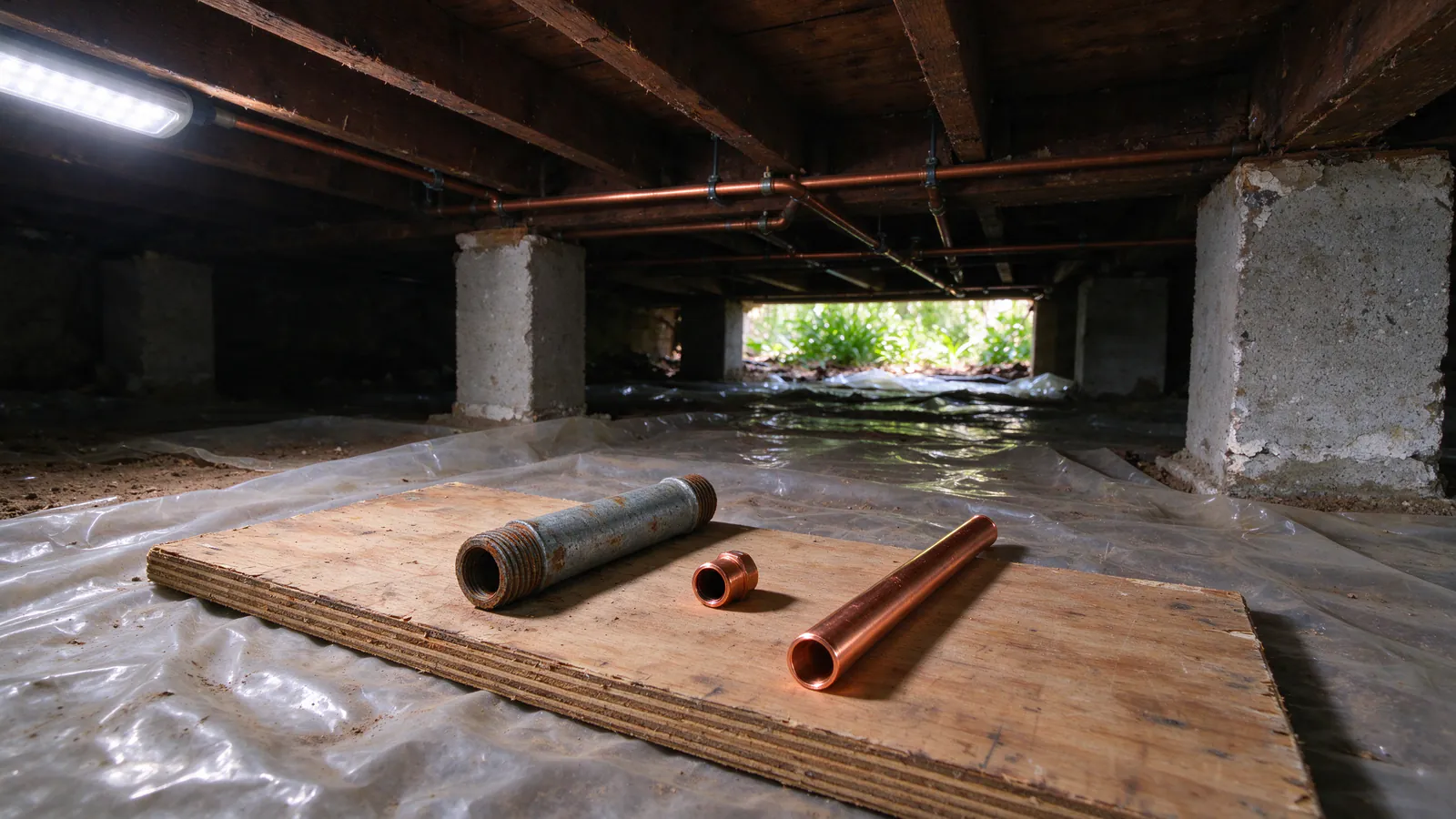
The house’s age tells you what was common when it was first plumbed: galvanized steel through roughly the 1950s and 1960s, copper after that. But an older house has usually been repaired several times, so the original pipe may now sit next to copper, CPVC, polybutylene or PEX added later. Every one of those transitions is a potential weak point.
A 1950s house might have galvanized in the walls, a copper section where a slab leak was fixed, CPVC from a bathroom remodel and PEX at a newer water heater. Each fails differently, and metal-to-metal transitions without a dielectric union or listed transition fitting can corrode faster. Our pipe identification guide helps you see what you have, and the guide to brown water and rusty pipes explains how galvanized fails.
Mixed systems also complicate the repair or repipe decision, because fixing one section of galvanized can stress the next.
What we check first in an older house
We spend more time up front: mapping each material, finding earlier repairs, checking the main shutoff and water heater connections, confirming attic and crawlspace access, and agreeing with you how plaster, tile and built-ins will be protected. Your written scope says how we’ll handle anything hidden that turns up.
Pier-and-beam or slab?
Some early-1900s Dallas houses sit on pier-and-beam foundations with a crawlspace, which can make it easier to run new lines under the floor. Postwar ranches are more often slab-on-grade, where new lines go overhead through the attic. Both routes need insulation and freeze protection; our guide to attic pipe routing and freeze protection covers the attic side.
What might be behind the plaster
Opening a wall in an older house can turn up rotted framing from an old leak, knob-and-tube wiring, abandoned pipe or pest damage. None of that is plumbing, but any of it can hold up the job. We agree with you up front how we’ll report a hidden condition and how it gets priced, so it never becomes an argument.
Will you lose your plaster and original tile?
Not if the job is planned right. We keep openings as small as practical and place them where attic, crawlspace or closet access can do most of the work. Plaster on lath gets scored and cut carefully so it doesn’t crack past the opening. Original tile, built-ins and wood trim are protected or worked around, and the restoration scope names who matches each finish.
Restoring plaster takes different skills than taping drywall, and matching an old texture or a hand-troweled finish can take longer than the plumbing. Our guide to wall openings and drywall repair lists what a restoration scope should name. If a plaster wall is too fragile to patch cleanly, a drywall overlay in that area may be the better answer; we settle that with you before work starts.
Repiping a house with original plaster or tile?
We map the pipe, the access and the finishes, and put restoration in writing before a wall is opened.
Lead paint and other old materials
Houses built before 1978 may have lead-based paint. The EPA’s Renovation, Repair and Painting Rule requires anyone paid to do work that disturbs painted surfaces in pre-1978 homes to be certified and follow lead-safe work practices. Some older materials, like textured ceilings or old pipe insulation, may contain asbestos and should be tested before anyone disturbs them.
The EPA’s RRP program page explains the rule. Ask how containment, cleanup and verification will be handled in your house. If a suspect material turns up mid-job, work in that area stops until it’s tested.
Your pipes may be grounding your electrical system
In many older houses, the metal water pipe was part of the electrical grounding or bonding path. Replacing galvanized or copper with PEX can break that path. Have an electrician check grounding and bonding during or after the repipe so your electrical system still has a proper ground. It’s separate work, and we line up the timing with you.
The same check is worth doing if any metal pipe stays in service after a partial repipe.
Do historic districts change anything?
Historic review in Dallas applies only to properties in mapped historic districts and landmarks, and it generally looks at the exterior rather than the plumbing inside. If a repipe touches the outside, such as a new hose bib, a wall penetration or exterior equipment, check with the City’s historic preservation office before work starts.
Start with the house you have
Start with what you know: the pipe you can see, the leaks you’ve had and the finishes you want protected. On the first visit we map the materials and the access, and your written estimate says how hazardous materials, hidden conditions and restoration will be handled. If galvanized is the main problem, our galvanized pipe replacement page covers that job. Get an estimate to begin, or read the Dallas home repiping guide for the full picture.