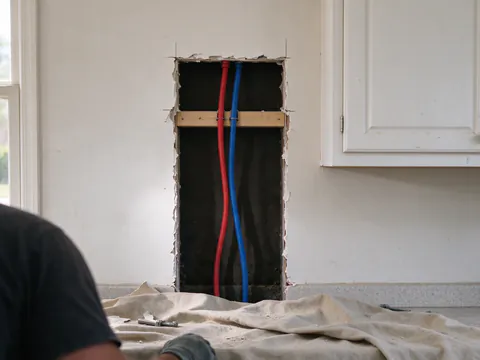
You run the shower in the far bathroom, go make coffee, and come back to water that is still lukewarm. A leak behind the kitchen wall means shutting off the whole house, because one valve controls all six bathrooms. Or the remodel crew has opened the primary bath and found the original copper, thin and green at every joint. In a large North Dallas house, the pipe material is usually the easy decision; the layout is the hard one.
Fullbore Dallas Repiping replaces water supply lines in North Dallas homes, from a single wing to the whole house. We count the fixtures, measure how far each one sits from the water heater and plan a layout that fixes the wait and the shutoffs, not just the old pipe. The whole-house repiping page shows what a complete scope includes.
Waiting on hot water at the far bath
The wait is about distance and volume. Every foot of pipe between the heater and the tap holds water that has to run out before hot arrives. Replace old pipe along the same long route and the wait stays the same, or gets longer if the new line is larger.
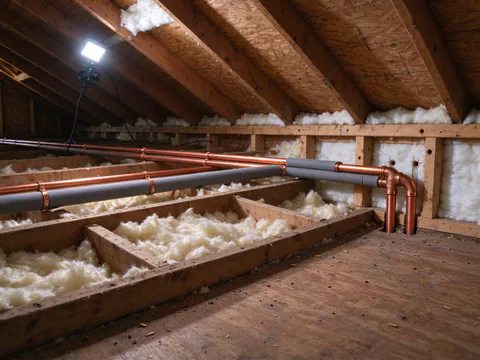
So we plan for it. That can mean shorter routes through the attic, right-sized hot lines, a second water heater closer to a far wing, or a recirculation loop. Our guide on slow hot water after repiping explains why the layout matters more than the pipe. If the hot side is the only thing failing, a hot water line replacement may be the narrower answer.
One valve for the whole house?
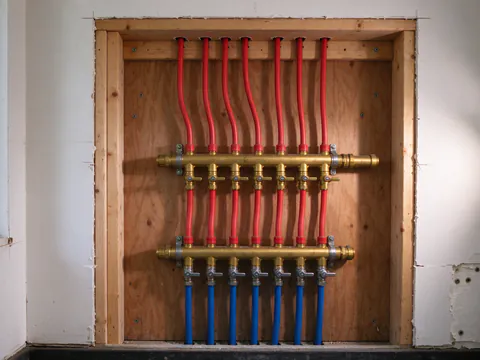
In a big house, being able to shut off one bathroom without shutting off the rest is worth a lot. A home-run manifold runs a separate line to each fixture from a central point, each with its own shutoff. Trunk-and-branch runs a main with branches and uses less pipe. In a house with fixtures spread across separate wings, several zoned manifolds often work better than one. Our guide on manifold versus trunk-and-branch compares the two.
Pinholes in 1960s copper
Many older ranches here still have their first copper, often thin-walled Type M. When pinholes start turning up in different rooms, each one costs a patch, a hole in the drywall and a day of disruption. Where the leaks fall tells us more than how many there are, and our guide on recurring pinhole leaks explains how to log them so we can read the pattern.
A hot line under the slab is the other common failure. A warm spot on the floor or a meter that turns with every tap closed points there. A single slab leak reroute may be the right first step; a second leak on another line is usually when we talk about moving all the supply overhead.
What your estimate should list
A short estimate for a big house leaves too much open. Ours names each of these in writing:
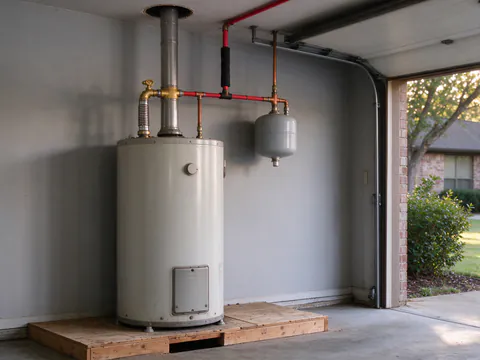
- every water heater it reconnects, with the transition fittings and any thermal expansion tank the closed system needs
- the recirculation pump and return line, if one is planned, and where it ties in
- the PRV, where it sits and whether it is replaced or kept
- the outdoor lines it covers, such as hose bibs and a pool fill, and the ones it stops short of, such as irrigation
- the stops, stub-outs and escutcheons at each fixture
- the pressure test and flush before walls close
- the under-slab lines being abandoned and how they are capped
- the drywall, texture and paint restoration, room by room
Keeping the house running during the work
With several bathrooms, we can usually build the new system alongside the old one and switch over in a single cutover, so you are without water for a shorter stretch. Some baths can stay in use while others are worked on, depending on how the work is staged. A guest house, outdoor kitchen or pool may have supply that runs outside the main structure, and the scope says which of those are in and which are left alone. Our guide to repiping water shutoffs covers how that day is planned.
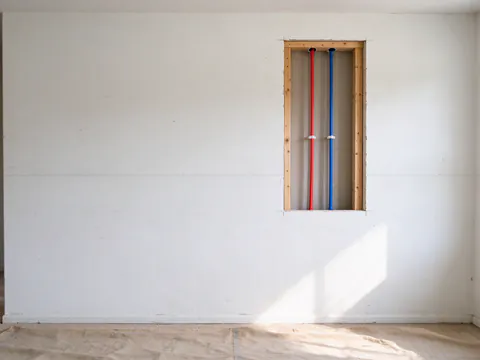
Copper and PEX are both allowed in Dallas when listed and installed to the code and the maker’s instructions. Copper repiping uses rigid pipe with sweat or press-connect fittings; PEX repiping bends around framing and usually needs fewer joints. Most owners decide on budget, preference and how the route works through the attic.
Neighborhoods in North Dallas
Preston Hollow
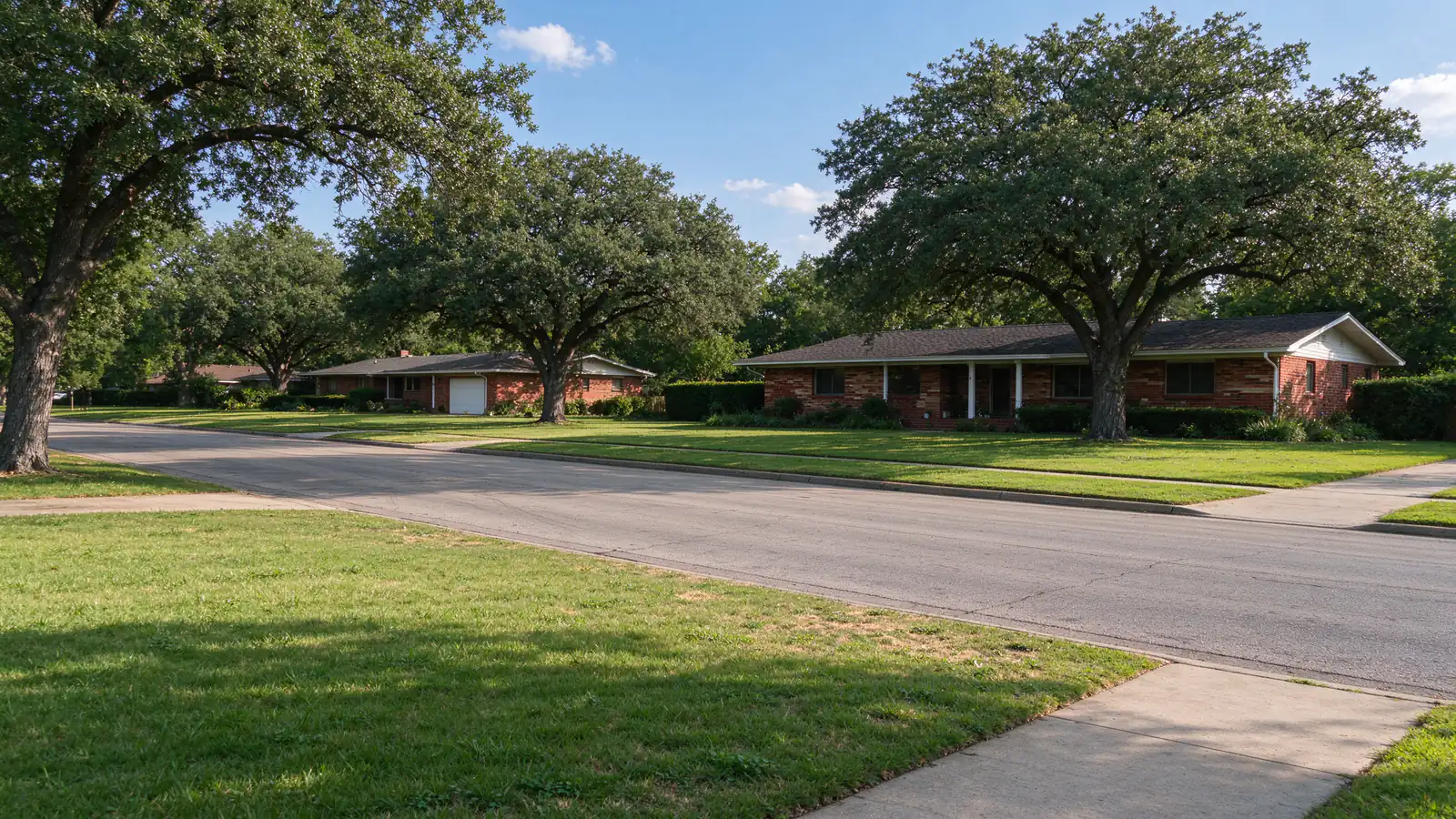
Preston Hollow covers parts of ZIPs 75225, 75229 and 75230 and includes some of the largest lots in the city, with mid-century ranches beside recent rebuilds. A mid-century house with several remodels behind it can carry three or four generations of pipe: original copper, later CPVC or PEX in redone baths, and transitions between them. If you are remodeling, repipe while the walls are open and before the rough inspection.
Finished ceilings, built-ins and detailed trim make the location of each drop matter here. We plan routes through closets, pantries and the backs of cabinets to keep openings out of the main rooms. If you plan to move or add a bathroom, settle that first so the new lines go to the final fixture locations.
Plan a North Dallas repipe around your home's layout.
Tell us the number of bathrooms, where the water heaters sit and which taps are slow to run hot. We start there.
What the records show for 75225, 75229 and 75230
The Census Bureau’s 2020-2024 American Community Survey estimates show three different ZIPs. ZIP 75229 is the oldest, with a median year built of 1967 and 73.2% single-family houses. ZIP 75230 has a 1979 median, and ZIP 75225 is newer at 1989.
As general trade history, Dallas houses from the 1960s and 1970s were usually plumbed with copper, often Type M, and houses from the 1980s may also have CPVC or polybutylene. Many have been remodeled since. Since January 2024, City of Dallas open data shows 6 permit records in ZIP 75229 and 4 in ZIP 75230 that explicitly describe interior water-supply repiping, counting only records whose descriptions say so.
The City’s ForwardDallas plan places much of North Dallas in the NC-1 planning district, mostly residential with corridors along Preston Road and Northwest Highway.
Pricing and next steps
We price a large house after the first visit, from fixture and bathroom count, total pipe length, attic access, the number of water heaters, recirculation, the PRV and room-by-room restoration. The repiping cost estimator walks through those drivers, and our guide on the repiping process and timeline shows what happens from the first visit to the final inspection.